Are Churches Destroying Cultures?

In Building a Healthy Multi-Ethnic Church, Mark DeYmaz describes a five stage continuum of growing cross-cultural competence. Over the next month I’m going to spend some time discussing each of these stages. Here’s DeYmaz’s introduction:

So how can those of us committed to Christ and to the local church pursue cross-cultural competence and avoid ethnocentrism? Although there are a variety of ways to go about it, we should first understand that it will be an ongoing developmental process. We see a cultural continuum moving from destructiveness to blindness to awareness to sensitivity to competence. (p103)

Cultural Destructiveness

I hope that this first stage is never present in a church. DeYmaz includes  a quote that at this level “the emphasis is on using differences as barriers.” People with this mindset acknowledge only one way of being and intentionally seek to subdue and eradicate other cultures.

Examples given of this stage of cultural competence include the ethnic atrocities arising in Nazi Germany, Rwanda, Bosnia, Darfur. Attempts to “reform” native cultures in the United States by forcing Native Americans to Westernise and the tragedy of the Stolen Generation in Australia also fall under this heading.

The goal of multi-ethnic churches is to respect all cultures, not force all cultures to dissolve into the dominant culture of the church.

So while Cultural Destructiveness is never (should never be) a goal of the church, it remains a great fear that hangs over race relations within the church.

Here’s an example from my personal experience.

Australian’s love to watch American movies and TV shows. There’s a lot of them. Some of them are great. Some connect with niche audiences. They generally have high production values and talented writers and actors. What’s not to like?

This movie raises some of the issues in the Australia – US relationship. I thought it was very well done.

In contrast films made in Australia telling Australian stories have much smaller budgets. The writers and actors do a terrific job, but the movies always seem to lack the Hollywood glitz. Australia doesn’t have super spy agencies. Australia doesn’t have the super glamourous rich and famous segment of society. Basically, Australia just lacks the same “cool factor” that American movies seem to ooze. As a result less people watch them.

That’s simply the market realities. There is no secret US plot to take over Australia and suppress Australian stories and destroy the Aussie culture. (or is there???) But when kids who need the police in an emergency dial 911 instead of the Australian emergency number 000, the influence is undeniable. Aussies then become defensive toward Americans as a way of protecting their cultural identity and independence.

Can you picture this same process taking place in a church setting?

While teaching English to immigrants can provide a valuable service to that community, if immigrants are expected to always speak in English in the church they will always be outsiders. If the church doesn’t support the learning of the parent languages among 2nd generations, it may appear that the church is on a mission to Anglicise and Westernise all immigrants as much as it is to worship God.

If US churches make a big deal of Independence Day celebrations, but fail to acknowledge Martin Luther King Day, or Chinese New Year they silently make the statement that only one culture is important. Sometimes churches feel good because their Chinese members celebrate the Lunar New Year together and it’s on the church calendar, but no one really expects the whole church to attend. Yet for the Labor Day picnic the entire church body is expected to be in attendance (including the Chinese members).

While an initial survey of this continuum may tempt us to disregard the first stage, it really needs to be considered. While only in rare and extreme situations would a church actually say “we don’t want a particular racial group or culture to enter our church”, the fear of cultural destruction is very real for minority groups within a church. “Do we have to give up our racial and cultural identity to become part of this church family?”

Churches and individual Christians need to make the conscious decision that we will not only love and embrace people from other races and cultures, we we will also do our best to welcome their culture. One way we will demonstrate our love is by expressing interest and value in the customs of cultures we don’t know well.

Do You Know Your Community?

Race map USA 2010

The above map purports to show each person identified in the USA through the 2010 census. If you click on the map above you’ll go to the original site that allows you to move around and zoom in on your community.

This isn’t really the typical material promoted on this blog, so let me explain.

I suspect that most churches have little concept of the racial makeup of their community. We often function based upon our impressions as we shop and drive through the neighborhood. Perhaps particular parts of our towns and cities have reputations for having a lot of residents from a distinct culture.

The risk with functioning based upon impressions is that appearances can easily deceive us. Yes, the majority of our neighbourhood may well be black or white, but the apartment complex down the road may have a large Indian population. We may not see many Indian restaurants or businesses because while the live in our neighbourhood, they work and shop elsewhere in the city.

Churches can’t serve our communities effectively, if we don’t know who lives in our communities.

Really knowing our community requires research and asking questions. So I submit the map above as a starting point. Zoom in on your city and see if it matches your impression. Did you find any surprises? Please leave a comment and share your thoughts.

Personally, I found a lot more red dots in my city than I expected. (They do seem to stand out more than the green and orange.)


What’s in a Picture?

This week a friend shared an article with me about university marketing. It told the story from 2000 when the University of Wisconsin wanted to portray itself as racially diverse in its recruiting material. Somebody had the bright idea that Photoshop would help them out. So the front cover of the 2001-02 application booklet features a scene from a football game with the photoshopped head of a African-American student who never attended a football game!

This illustrates the difficulty institutions such as colleges and churches have when portraying themselves. Unless a church is targeting a particular demographic sector such as young professionals, or a specific immigrant community, churches want to portray themselves as welcoming to everyone. As a consequence our websites and promotional material often emphasises diversity. However, these pictures don’t always tell the truth.

The difficult question to answer is “Should we portray the church accurately, or aspirationally?” How does a 98% white church communicate that black and Hispanic members are welcome? Does a picture of a room full of white faces communicate that message? But if a church posts a stock photo of great racial and generational diversity that’s not a current reality will guests feel deceived when they walk in the door?

Did we miss anyone?

Look at this picture I found in some search results for “church diversity”. It’s obviously staged, but they’ve managed to include quite a few demographic groups: Children, Men, (mostly) Women, African-Americans, 50+, and they’re all so happy!!

One suggestion I like is that if congregational is more aspirational than real, “Start making it real!” Obviously churches can’t drag ethnic diversity in off the street, but they can develop an attitude of diversity by deliberately including diversity in everything we do. If we begin with intentionally including generational and gender diversity on committees and ministry teams, we’ll develop an attitude toward inclusiveness that will prove invaluable when connecting with those of other ethnic backgrounds. Don’t let pictures be the only expression of the church’s aspirations for diversity.

This is a topic I’m sure we’ll explore further in later posts. Churches that are racially integrated really should get that message out. Remember, 93% of churches are not! But what’s the best way of letting our communities know who we are?

In the meantime, I’d love to hear your experiences. Do you think the picture above is positive or negative? You might also like to read these related articles:

On Earth As In Heaven

This article was originally posted on the website www.GodMeetsBall.com in May 2013. Since football has become such a big part of the Christmas season in the US I thought it would be appropriate to share these thoughts here. I hope all my readers have a wonderful Christmas with those you love.

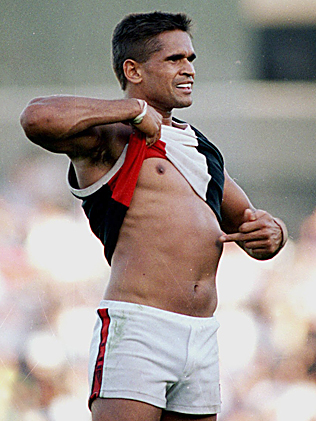
I remember the iconic picture on the news and in Australian newspapers 20 years ago. St. Kilda’s Nicky Winmar raising his guernsey in defiance after enduring an afternoon of racial abuse from the fans outside the fence. In 1993 it set off shock waves around the country. The profile of the “aboriginal issue” instantly grew on the public’s consciousness, not only in terms of national political policies, but in respect of individuals examining our own actions for racism. (Click HERE for a good short reflection on this event.) The fact that there’s still much work ahead is demonstrated in the abuse Adam Goodes received during a match this weekend from a 13 year old girl. (Read his reaction HERE.)

This might seem strange to many people today, but I graduated high school the year before and I don’t remember ever having a conversation about racism and the hurt it causes. There may have been other events that also placed racism on the public consciousness, but for young white males who admired Winmar as a superbly skilled football player, this image made an impact.

In the USA Jackie Robinson is honoured as the first black player in Major League Baseball in 1947. Just as the AFL now has an indigenous round each year, MLB also celebrates Jackie Robinson Day annually.

Sports have always had a close connection to race relations. Sometimes sports leagues, players and fans have disgraced themselves, but sports have also made some important contributions in race relations. Sometimes these improvements have come through official actions and at other times by unofficial events.

For many, Tiger Woods has become the face of a new generation with a bi-racial heritage and a drive to allow his talent to transcend racial issues. Although not the first black golfer on the PGA Tour, Tiger is certainly the most well-known and today the only African-American playing on the Tour. This past week Sergio Garcia found himself in hot water after making a “joke” about Tiger and fried chicken. Again demonstrating the work still to be done. This interesting article contained this description of Tiger,

It’s not Tiger’s way to bring attention to any aspect of his racial heritage. His aim is to transcend race through excellence as a professional golfer. He reaches for a higher plateau that is post-racial in a way that not even President Barack Obama could ever attain as a self-identified African-American.

One of the cruel ironies of Tiger’s hope for racial transcendence in a sport played predominantly by whites is that he has been both a symbol of racial harmony and a polarizing force along racial lines.

Apart from the statements made on the field, sports provide a unifying rallying cry for people from all backgrounds. Whether listening to a radio in the poorest hovel, or sipping wine in a corporate box, people connect by supporting the same team.

When I worked as a college minister in Melbourne, Australia, we had a large group of international students attending our church. I encouraged them to pick a football team, any team, and even if they weren’t interested at all, keep track of the team’s season from a distance. This would help them fit in with the local people they met and serve as a great conversation filler. Everyone has a favourite team. Even if your team is different to mine, at least an interest in the sport provides a commonality.

So if sports can unify fans across racial, educational and financial divides. And if sports can make strong statements opposing racism that impact society as a whole. The church has a lot of work to do to match the camaraderie of sports teams.

  • How do we welcome people different from ourselves?
  • Are our friends mostly like us, or do they reflect our community?
  • Shouldn’t the church be ahead of the local sports team, which basically are businesses, in acting as instruments of Godly social change?

Even today, many church growth consultants promote the idea that homogenous churches will grow more quickly than integrated, diverse congregations. I know churches that insist that they need to be racially black, or white or Chinese, or Latino to help them serve that particular ethnic community.

These might be valid reasonings. Even if they are, they shouldn’t apply to as many churches as they do. According to a 1999 survey (cited in One Body, One Spirit, George Yancey), only 8% of all US churches are multiracial. (I suspect this would be much higher in urban & suburban Australia, but I haven’t found any data.)

In Matthew 6:10 Jesus prays, “May your will be done on earth as it is in heaven.” What is God’s will for race relations and the church? Let’s answer that by looking at heaven. Revelation 7:9 describes “a great multitude that no one could count, from every nation, tribe, people, and language standing before the throne an in front of the lamb” praising God. Wouldn’t it be wonderful if that described our churches, “on earth as it is in heaven”?

Multiracial Churches Attract Interracial Families

God has blessed our church over the past few years as we regularly have newcomers attend our worship services. We place a lot of emphasis on hospitality toward guests and when someone attends several times I try to sit schedule a coffee with them as an opportunity to get to know each other. During these conversations one of the questions I ask is, “What do you like about our church?”

This past week I had coffee with a new guest and she volunteered that although she was white her boyfriend was African-American. She told me that she had invited him many times to attend her previous congregation but he had no interest in being the only person with black skin in a large room. She went on to say that she is hopeful he will attend church with her now that she has found a congregation in which neither of them will stand out.

Earlier this year I met with another couple (African-American & Jamaican) who said they really liked our church because it reflected their broader experience in society. They wanted their children to grow up playing with children of other races. They also wanted their children to grow up with Christians of other races.

This is a growing trend.

At this point in our congregation’s life our leadership team is glaringly white. We only have one black deacon. But we do have an elder in an interracial marriage and an international minister [me] married to an American. While not a huge percentage, 10-15% of our married couples have interracial marriages.  Finding a church that not only accepts them, but supports their marriage and families is important to these couples.

This article provides some keen insight into the challenges biracial families face. If you take the time to read it, you’ll quickly see the importance for churches to provide safe places for these diverse families.

I’m not going to pretend that I’ve done a lot of reading or research on interracial marriages, but I did stumble across a USA Today article highlighting the growth in interracial marriages. According to the study it was reporting on, “In 2010, 15% of couples married outside their race or ethnicity.” In 1980 just 3.2% of all marriages in the US were interracial. Thirty years later the number has more than doubled to 8.4%.

How does this trend impact churches?

One area of impact will be classes related to marriage or parenting. This is more than newlywed couples discussing whether their families of origin drank full cream or skim milk. Interracial couples and parents need to discuss which elements of their ethnicity they will integrate into their married lives and pass on to their children.

  • Which holidays will your family celebrate?
  • Are there particular foods which posses a significance to you beyond taste?
  • How will you help your children settle upon their unique identity? (In the first article above the author describes herself as “a biracial, self-identifying, culturally & ethnically black American woman.”)
  • In your marriage, are you free to ask questions related to race? Will you accommodate each others learning?
  • If the married couple have different native languages, what languages do you want your children to learn? How will you teach them?

Communication about differences is super important for all couples, but interracial couples do face some distinct issues that require special attention. Multiracial churches will do their communities a favour by developing awareness and supporting the challenges interracial families face.

Review: Many Colors

Mike Price is the minister at the Bogalusa Church of Christ in Louisiana. He introduces himself further below. This is his first contribution to Cultural Mosaic. You can browse more of his writing on his personal blog, http://drmikeprice.com/.

Sometimes you really find a treasure.  They are the unexpected events that exceed your expectations.   Like taking a stroll on the beach and finding an old coin.  A real surprise!  On top of that you find out the coin is valuable!

Just over four years ago my wife Nancy and I decided to go back into the mission work.  It is a stateside mission work in Bogalusa, Louisiana.   It is truly different from the foreign mission work we experienced in Kowloon, China for 3 years, where my daughter was born and we worked only with Chinese.  Bogalusa is a multicultural/multiethnic mission work, consisting of 51% black, 47% white and 2% Hispanic.  An interesting side note is that the demographics of Bogalusa are an identical match with the church I work with.

As a result of this setting I have read and researched a lot of material on multicultural/multiethnic congregational life.  I am familiar with mixed communities, because in my first twelve years of schooling I attended 12 different schools.  Sometimes I attended as many as three different schools in one year and I lived in more than one mixed neighborhood.  Our first preaching job while supporting myself in school was with and all black congregation and was a great experience indeed!  In my preaching life most of the gospel meetings I have conducted have been for black congregations.  This has not happened out of any design, it has just worked out that way.   God has blessed me, and continues to do so, with a variety of experiences and challenges in life.

Even with my past and present experience I need to make sure as a missionary and minister, that I am able to promote and encourage a culture in the congregation that is not dominated by any one culture or ethnic group.  We need a balanced culture from God’s prospective that reflects the multicultural/multiethnic reality of our congregation.  This is easier said than done, but it is taking place and continuing to improve.

We are establishing a single congregational culture and practice that honors all groups represented.  This goal has provided my motivation to research and gain God’s perspective for his church in a changing multicultural/ multiethinic congregation. Our nation is fast becoming a multicultural/multiethinic society, moving in a direction where there will not be one dominate culture or ethnic group.

Peter Horne introduced me to a list of books on the subject and I asked Lawrence Rodgers who is working in multicultural congregation, which book he would like to see a book report on and he picked “Many Colors.”  To my surprise “Many Colors” by Dr. Soong-Chan Rah, was like finding a valuable coin while taking a stroll down the beach and being totally surprised.  It sums up so well and with clarity, what I have experienced and lived through. Rah also gives me more information to work with, which will allow me to become a better minister for Christ – increasing my cultural intelligence.   The book is written in a way that anyone who reads it can digest the information and intent of the book.

Soong-Chan Rah, points out that culture may operate on three levels which reinforces what and where we are culturally.

  1. Behaviors that are learned,
  2. Ideas that reinforce beliefs and values, and
  3. Products that reinforce beliefs.

He does and outstanding job of pointing out biblically God’s view of a multicultural and multiethnic reality that God wants for the church and how this is possible to achieve.  Since cultures are God’s intent, Rah points out they are, “not inherently evil, but rather are an expression by fallen humanity to live into the high calling of the Imago Dei (Imago Dei – Image of God)…Our goal in cultural intelligence therefore, is not to erase cultural differences, but rather to seek ways to honor the presence of God in different cultures. When we are dealing with cross-cultural and multicultural ministry, it is important to see God at work in all cultures, not just in one.”

I loved it when Dr. Rah quotes David Bosch in “Transforming Mission,”

“Mission is primarily and ultimately, the work of the Triune God, Creator, Redeemer, and Sanctifier, for the sake of the world, a ministry in which the church is privileged to participate.”

I hope you will take the time to read “Many Colors,” it will bless your life!  Whether you are in a multicultural/ multiethnic congregation or not, “Many Colors” will open up avenues of success in your own personal evangelism and capacity to reach out to a truly multicultural/multiethinic nation that we are becoming, increasing your cultural intelligence.

Eight Great Quotes from Eight Books

Lawrence W. Rodgers is a Christ-follower, husband, father, friend, servant, minister, and blog author. His blog is SeekingFirst.org, were he writes about practical theology, faith, family living, Christian living, and other relevant matters from a Biblical perspective. Lawrence is a full time minister, and is dedicated to seeking first the Kingdom of God in all areas of life. I appreciate him sharing this blog post with Cultural Mosaic readers.

No other task I have ever attempted to take on in my ministry has been as taxing as the task of encouraging homogenous congregations to grow into heterogeneous congregations.  No other cause I have ever endured has produced as much pain as encouraging multiethnic, multiracial, or multicultural diversity in congregations.  I have never had my efforts called into question more for any other endeavor as this one.  In my efforts, I was once asked the disparaging question if I had an agenda, I sternly replied “No!”  But, I have rethought my answer, and the answer is yes!  I do have an agenda, and that is the Jesus agenda, and within in it is the call to help the church to grow into the prayer Jesus prayed in John 17, or to help in Jesus decree for it to be on Earth as it is in Heaven.  Heaven, according to Revelation 5:9, will be the most diverse place any of us have ever experienced, and we should all work towards it being on Earth as it is in Heaven. 

This calling has not been an easy one.  However, it is a needed one.  In this article, I will share eight great quotes on congregational diversity from eight great books I have read.  These books have helped me to find encouragement along this road, and I hope they will encourage you as well. Maybe, these quotes can challenge others, and help use rethink congregational diversity, and the importance of it.

 Many Colors: Cultural Intelligence for a Changing Church

“The work of cross-cultural ministry is a difficult one. If the task of building a multiethnic church were an easy one, then every church in America could be experiencing the joys of successful multicultural ministry. Instead, most will recognize that planting, developing, and nurturing a multiethnic and multicultural church is extraordinarily hard work. In fact, if you are finding multicultural church ministry to be easy work, I would wonder if you are engaging in a multiethnic church but within a monocultural context. In other words, your congregants are adapting to one set of preferences, and they are not expressing the fullness of their own culture but instead acquiescing to the dominant culture. That type of church can be exciting and dynamic, but it would not require cultural intelligence. In fact, it would call for cultural oblivion.

The call to build a multiethnic, multicultural, racially reconciled church is an extremely high calling. There are numerous obstacles in society and in our human nature that could prevent us from living into God’s calling for our church. We must recognize, however, that this calling to be a diverse community that truly represents the kingdom of God requires great sacrifice. The deeply seated demonic power of racism cannot be overthrown without great cost.” [1]
Missiology: An Introduction to the Foundations, History, and Strategies of World Missions

“How can the concept of multiculturalism be applied to the church scene? Simply having persons from different ethnic, racial, or national groups does not necessarily make a multicultural church. This mixture of ethnic, racial, and national peoples might make up a multiracial church. The degree to which a church might be multicultural depends on the presence of certain clues or signs. These signs are not absolute but relative.

The signs might include leadership that represents the various ethnic/racial groups. Another visible sign would be the worship style. Does the worship style represent the methods and means of each of the groups within the congregation? The evidence of multiculturalism would be when the music, the preaching style, and the worship format might not be recognized as being easily connected to only one cultural expression.

The search for signs could go further by examining the leadership style and the church governance, both of which are culturally influenced. In a multicultural church, there would be appreciation and accommodation to the different styles of the cultures represented in the church’s membership.” [2]

The American Church in Crisis:Groundbreaking Research Based on a National Database of over 200,000 Churches

“The third key influence of multiethnicity is its challenge to power and privilege. In America these qualities have been the domain of Anglos. Jesus presented a countercultural view of these two traits when he challenged the Roman view of power and authority with the model of servanthood. Unfortunately, American Christians have often allowed the world to determine their view of power and privilege, rather than Scripture. This has created an Anglo Christianity that is increasingly affluent, suburban, and educated, yet functionally disconnected from non-Anglo populations. A multiethnic church will bring to American Christianity a new awareness of these issues from a biblical perspective so that the new people of God, the church, may truly reflect the diversity and equality inherent in the gospel.” [3]

Race and Reconciliation: Healing the Wounds, Winning the Harvest

“Jesus exhorts us to count the cost before we begin any endeavor (Luke 14:28). There is a definite cost to the development of multiethnic ministry. A large number of people who simply could not adjust to the changes in our congregation left the church. Some of those brothers and sisters were very close to my wife and me. I remember the Sunday that one of our church council members came to me asking, “Just who are we trying to get into this church anyway?”

I responded, “People who are hungry and who know they need the Lord.”

On the other hand, some of our black brethren have suffered criticism and racial slurs from their own people because they have chosen to attend a church pastored by a white man. We must realize that deep prejudices have been ingrained in people from childhood. Once we have a clear perception of this matter, we are enabled to respond in love, instead of reacting in anger.” [4]

Multicultural Ministry: Finding Your Church’s Unique Rhythm 

“For the disciples to obey the Great Commission, they had to face the inevitability of cross-cultural, multiethnic ministry. At the very start of the first-century church, Peter and the other apostles confronted racial and ethnic challenges head on. Remember the story of the first deacons? The Hellenistic, Greek-speaking Jews were murmuring that their poor widows were not receiving fair distribution from the wealthy. The Aramaic-speaking Jews, like the apostles themselves, had neglected this minority group. The apostles addressed the problem by appointing Greek-speaking deacons to serve the widows. The first church practiced the dance of cross-cultural ministry and multiethnic evangelism from the outset, because of the Great Multiethnic Commission.” [5]

The Lamb’s Agenda: Why Jesus Is Calling You to a Life of Righteousness and Justice

“THIS NEXT GREAT VERTICAL AND HORIZONTAL righteousness and justice movement will not be a white, black, or brown movement, but rather a kingdom culture, multiethnic movement.

Notice how I did not say multicultural but multiethnic. The “culture” we all share—or can share—is God’s kingdom culture. We can share in it whether we are black, white, or brown, or whether we are Americans, Egyptians, or Greeks.” [6]

Erasing Hell: What God Said About Eternity, and the Things We’ve Made Up 

“Why is it that only 5.5 percent of American evangelical churches could be considered multiethnic (where no single ethnicity makes up more than 80 percent of its congregants)?1 Why is that? Five and a half percent! And we’re supposed to be living in the melting pot, the place where hundreds of languages and colors often live within a few miles—or feet—of each other. What’s so sad about this is that many people outside the church are far less racially divided. Consider the military, our places of work, or athletics. Yet there are three places where racial division still persists: bars, prisons, and the American evangelical church.

We need to see the glaring contradiction in saying we believe in hell while making no effort to tear down the walls of racism and ethnic superiority. If we’re going to take Jesus’ words seriously, we have to make a more concerted effort to forge avenues of racial reconciliation and unity under the banner of the gospel of Christ. One day, Christ will come back and there will be an amazing worship celebration—with African bongos, Indian sitars, and an ensemble of Mariachi trumpets—where every tribe, tongue, nation, and color will bow the knee to their King and celebrate! If this sounds irritating, then go back and read Matthew 8. It’s written for you.” [7]

Gospel-centered Discipleship

“Interestingly, when the church embraces the second conversion to community, very often the third conversion to mission follows. A Jesus-centered community is an attractive community—a community that encourages, forgives, serves, loves, and invites non-Christians into its community. The gospel reconciles people to God and to one another, creating a single new community comprised of an array of cultures and languages to make one new humanity (Col. 2:15). This new humanity reconciles its differences (Col. 2:14–16) in the commonality of the gospel. It is both local and global. As the body grows, a redeemed, multiethnic, intergenerational, economically and culturally diverse humanity emerges. When we act as the church toward one another, we display the gracious, redemptive reign of Jesus to the world. As Jesus’s redemptive reign breaks into this world, the church grows into the full stature of Christ.” [8]
Thanks for Reading!
~Lawrence W. Rodgers


[1] Soong-Chan Rah, Many Colors: Cultural Intelligence for a Changing Church (Chicago, IL: Moody Publishers, 2010).

[2] John Mark Terry, Ebbie C. Smith, and Justice Anderson, Missiology: An Introduction to the Foundations, History, and Strategies of World Missions (Nashville, TN: Broadman & Holman Publishers, 1998), 578.

[3] David T. Olson, The American Church in Crisis: Groundbreaking Research Based on a National Database of over 200,000 Churches (Grand Rapids, MI: Zondervan, 2009).

[4] Jack W. Hayford, Greg Howse, and Michael Posey, Race and Reconciliation: Healing the Wounds, Winning the Harvest, Spirit-FilledLifeKingdom Dynamics Study Guides (Nashville, TN: Thomas Nelson, 1996).

[5] David A. Anderson, Multicultural Ministry: Finding Your Church’s Unique Rhythm (Grand Rapids, MI: Zondervan, 2009).

[6] Samuel Rodriguez, The Lamb’s Agenda: Why Jesus Is Calling You to a Life of Righteousness and Justice (Nashville: Thomas Nelson, 2013).

[7] Francis Chan and Preston Sprinkle, Erasing Hell: What God Said About Eternity, and the Things We’ve Made Up (Colorado Springs, CO: David C Cook, 2011).

[8] Jonathan K. Dodson, Gospel-centered Discipleship (Wheaton, IL: Crossway, 2012).

Is My Church Multiracial?

As I get this blog up and running, it’s important to establish some consensus of terminology. In my reading I have generally found broad disagreement on whether multiracial, multiethnic, multicultural, or something else are the most appropriate descriptors for churches with  members from a variety of racial or ethnic backgrounds.

At this point, I use multiracial and multiethnic interchangeable, although I recognise that some people may give the words distinct technical meanings. Multicultural seems to deserve its own definition as people of the same race or ethnicity can still have different cultures based upon characteristics such as social class or geography. I expect I’ll write more on this topic before too long.

Today, I specifically want to define the term “multiracial church”. Anytime I have a conversation with other ministers and mention that my church is multiracial, I invariably hear back something like, “Yeah, our church isn’t 50-50 or anything, but we do have a few [insert minority group here] that attend.” It’s as though 10 minority members in a church of 250 proves the church isn’t prejudiced and in fact is almost racially integrated.

The definition that I now use and I think is generally accepted is one I stumbled across in Yancey’s book One Body, One Spirit.

“I will define a multiracial church as a church in which no one racial group makes up more than 80 percent of the attendees of at least one of the major worship services.”

Notice that this definition focuses on the size of the majority race within the church rather than whether a particular minority group reaches a certain threshold. A congregation with 12 percent black and 10 percent Chinese would be classified as multiracial because the majority group is only 78 percent of the congregation.

The second aspect of this definition relates to the way racial groups integrate in worship. A historically white church that sponsors a Spanish language service in the gym would not meet this criteria as a multiracial church even if under the oversight of the same congregational leaders. A multiracial church must have a basic commitment to building relationships between races. While simply attending worship services together doesn’t guarantee relationship building, it’s a lot more likely to happen than if the two groups worship separately.

The 80 percent figure may seem like an arbitrary definition. Yancey addresses this in his book and states that “there is sociological evidence that such churches [meeting the definition] differ from monoracial churches.” Of course, that’s not saying there’s a huge difference between 81 and 79 percent, but simply that the church culture is significantly impacted when no single racial group makes up more than 80 percent of the church membership.

I appreciate this definition because it provides a firm benchmark in a sphere of thought that is often ambiguous. It’s not the only definition, and some would argue it’s not the best definition, but it’s a whole lot better than just using words and terms that have different meanings to each person.

Having a racially diverse congregation that meets this basic numerical definition of a multiracial church does not make any statement about the intentionality or racial health of the church. Such a church may not have racial diversity in its leadership or may maintain its traditional worship forms. However, defining a church as multiracial based upon its membership or attendance provides a fundamental starting point for churches to explore the numerous challenges that this diverse population presents to congregational life.


Is It My Turn To Speak?

Jason Whitlock writes headlines before he writes articles. He likes to get people’s attention. As an African-American sports journalist he often leverages his heritage to write from a “black perspective”. He commonly uses sports events as a basis for social commentary.

With that said, I found one of his recent articles very interesting. You can read it HERE.

In this article he uses a tantrum thrown by Dallas Cowboys wide receiver, Dez Bryant, as a springboard to make the point that his behaviour was not a product of his race. “Dez Bryant’s inability to control his emotions is not a racial issue. It’s a family dysfunction issue.” He goes on to write,

If this country wants to really invest in young people, we must first invest in restoring the traditional family unit. As long as 68 percent of black women who have children are unwed, there are no cures for the social maladies preventing black progress.

Much of the high-profile lawlessness and dysfunction we see in professional sports are a direct result of the impact of Hurricane Illegitimacy. It is not a coincidence that Bryant consistently struggles with his emotions and decision-making and [Calvin] Johnson does not. Johnson did not grow up amid chaos. He and his sister were raised by their married parents, who worked as a railroad conductor and an educator.

Anyone familiar with my work realizes I do not shy away from discussing race. It’s an important, vital discussion. But so is the discussion of family. In many respects, the conversations go hand in hand. The man-made factors energizing Hurricane Illegitimacy unfairly and, in my opinion, intentionally impact the black and brown family structures. The drug war and mass incarceration are targeted at poor, dark-skin communities.

I find his article compelling reading.

As a minister in a multi-ethnic church I have members that fit this demographic. Young black women in the pews each week who experience the social pressure to start a family without a husband. To what extent is the pressure greater on these black women than the white women sitting next to them? Because they all face some pressure.

As a white minister in a multi-ethnic church it is difficult to know how to address the issue. Perhaps I’m mistaken, but I do not believe a white journalist (or preacher) could safely write the article that Whitlock did. God absolutely requires all preachers to promote purity and holiness. God wants all preachers to uphold his design for stable, loving marriages and families. Yet the question remains, “In a multi-ethnic church how do teachers address issues that have greater prevalence within a particular cultural community?”

Do we avoid the issues? Should we never mention that 68% of black women who have children are unwed? Or just teach other topics? Or just address it in private, maybe even segregated, forums?

Do we treat everyone the same? Should we pretend that every member, urban and suburban, faces the same pressures?

Do we just lay it out there and let the chips fall where they may? Of course no one would set out to be offensive, but should a white leader discuss this issue as sensitively as he can even though in all likelihood it will upset some?

Do we find a black leader to address the topic? Does the race of the speaker make a difference? Should this make a big difference?

Whitlock himself recognises that this is a difficult issue to discuss, “The normalization of illegitimacy is so pervasive in black America that people are afraid to publicly address its dangers and consequences out of fear of being labeled a sellout or a racist. It’s been so normalized that some people honestly don’t believe it’s a problem.

On the one hand it’s a family dysfunction problem. On the other hand, it’s a family dysfunction problem that’s more prevalent (not uniquely prevalent) within the black community. Can multi-ethnic churches address one issue without addressing the other?

Without being specific Whitlock demonstrates the difference between racial and cultural issues. He compares Dez Bryant and Calvin Johnson. They are both super-talented, young, black, wide receivers playing in the NFL. However, their family upbringing is so disparate that it’s not fair to compare their personalities just because they play the same position or share the same race. The culture (or sub-culture if you prefer) that influenced them is completely opposite.

Johnson was raised in an environment that valued citizenship and education. In contrast, it’s a miracle that Bryant avoided the life of crime and drug addiction to which his mother succumbed. All at once the issue is racial, but also cultural. Church leaders need to be vigilant not to assume that because people have one trait in common they have all traits in common. For the 68% of unwed mothers there’s also 32% who are married. Who are you speaking to?

Leading a multi-ethnic church requires knowing your members more than your statistics.

Desegregating the Church

Do you know that only 8% of all churches in the United States meet the definition of multi-racial churches? THAT’S EIGHT PERCENT!! (Yes, I’m shouting that in shock and horror.) I’m blessed to serve one of those 8% but we need to keep reminding ourselves of the value of our racial makeup. It’s far too easy to take our racial harmony for granted.

DEFINITION: According to George Yancey a multiracial church is defined as “a church in which no one racial group makes up more than 80% of the attendees.

Racial harmony is not the Gospel of Jesus. Racial harmony is a powerful response and witness to the Gospel of Jesus and the power of God.

HARMONY Sunday 2013On Sunday our church celebrated it’s 4th Annual “HARMONY Sunday”. This special day celebrates God’s work not just in bringing two racial groups together 20 years ago, but on keeping them together for 20 years. Today our church consists not only of Anglo & African-Americans, but some Hispanics, and several other nationalities. We have members raised near the Gulf of Mexico, and others in the Dakotas. Undoubtedly, the Holy Spirit is the glue that keeps us together.

Our church forms part of the Restoration Movement. This group of churches has spent the past 200+ years calling the broader Christian community back to the forms and teachings of the first century church as described in the New Testament. This mission has been carried out more successfully in some areas than in others.

One aspect of the earliest church that the restoration movement has given little acknowledgement is the area of race relations. The pages of the New Testament are filled with examples and teaching relevant to Jew and Gentile relationships, but little application has been made to contemporary racial tensions. Churches of Christ are still as segregated as any other denominations in the United States.

I love God’s vision of his church as described by John in Revelation 7:9,

I looked, and there before me was a great multitude that no one could count, from every nation, tribe, people and language, standing before the throne and before the Lamb. They were wearing white robes and were holding palm branches in their hands.

God’s kingdom is multi-national, multi-racial, multi-ethnic, and multi-lingual. That crowd at the throne of the Lamb is our goal and destination, and there’s only one building. (See also Rev. 5:9-10 and 14:6) If it’s Jesus prayer, and it is, that “God’s will be done on earth as in heaven” then this vision of God’s throne, must be part of our vision for God’s church.

One of the problems churches encounter is that our vision for the church is too one-dimensional. We focus on doctrine over practice. Where we do focus on practice we often limit it to corporate worship. It’s interesting that throughout Revelation the throne scenes don’t describe a liturgy (order of worship), but they take considerable time to describe those present and worshiping.

HARMONY Sunday 2013-02That the church in eternity appears as a unified body should not surprise those of us who’ve studied the first century church. Acts 2 describes how the crowd on the Day of Pentecost, which became the first church, consisted of at least 15 language groups. Although they held Judaism as a commonality, one can only imagine various cultural customs and values this crowd brought with it from across the Roman Empire. It’s no surprise that one of the first church arguments involved the distinct cultural groups of the Hellenistic and Hebraic Jews. But they didn’t split!! They didn’t form distinct Hebraic and Hellenistic churches. That came years later. Rather, they worked to find a solution to the issues at hand.

God’s vision for a racially inclusive kingdom and therefore a racially unified church is found throughout the Bible. Here’s a just a few passages to consider:

  • Genesis 12:3 All peoples on earth will be blessed through you. [A messianic promise made to Abraham]
  • Psalm 67:2 May your salvation [be known] among all nations.
  • Isaiah 56:6-7 My house will be called a house of prayer for all nations.
  • Matthew 28:19 Go and make disciples of all nations.
  • John 3:16 God loved the world so much…
  • Acts 11:17 If God gave them the same gift he gave us… who was I to think that I could stand in God’s way? [The apostle Peter after baptising the Roman, Cornelius]
  • Galatians 3:8 Scripture foresaw that God would justify the Gentiles by faith…
  • Revelation 7:9 I saw a great multitude that no one could count, from every nation, tribe, people and language…

Perhaps the greatest challenge most churches face is overcoming indifference with intentionality. Most churches I’ve visited will say “Blacks, Whites, Indians, Chinese, Hispanics… Anyone’s welcome here.” But this is a very passive statement. What most of these churches don’t realise is that they’re really saying, “Any Black, White… person that comes here and fits into our existing culture is welcome here.”

diversity 01Hispanics may be welcome, but we’re not printing anything in Spanish anticipating their arrival. African-Americans may be welcome here, but we’re not learning any Gospel songs or celebrating Martin Luther King Day. Chinese Christians may be welcome here, but we have no clue when Chinese New Year is, and little interest in learning much about it.

If existing churches are to represent the kingdom of God as seen at the throne of the Lamb they must learn to be become aware of different cultures and cater to them. We must admit that our way of doing things is not the only way of doing things, even if it’s the way that makes us most comfortable.

WE MUST BE INTENTIONAL.

What does intentional look like? Mark DeYmaz describes how in the early days of Mosaic Church in Little Rock the church began to attract Hispanic guests. Before long, they began printing their church bulletins in Spanish as well as English. One week a well-meaning volunteer separated the different language bulletins to different sides of the entrance. Yes, this is only a small thing but DeYmaz notes, “Think about it: two separate tables, two separate groups.” That’s intentionality.

I love that as chapter 21 of Revelation (v1-5) describes God consummating his relationship with redeemed humanity, there are no longer any nations, races, people groups or languages. Rather, God’s dwelling place is simply “among His people” and “They will be his people, and God himself will be their God.” The only distinction among people are those with God in his dwelling place and those outside his city who rejected the forgiveness he offered.

Now there’s a vision for the church.