Recommendations

Although I’m passionate about the important role that multi-ethnic churches need to play in the kingdom of God, my own well is pretty dry on this topic at times. This is a primary reason I launched this blog last year. Sure, I have thoughts, ideas, experiences and reflections of my own, but I need conversations with others to be the leader my church requires.

Along the way, I’ve often been reminded that LISTENING is one of the most important skills for ministering, or participating, in a multi-ethnic church. I can’t speak into the lives and stories of my congregation if I don’t know their stories. If I’ve never heard their pain, I can’t be part of their salve.

So this week’s blog is simple. I want to point you to two excellent resources.

The first is an interview with Don McLaughlin. You will find it HERE on the Newsworthy with Norsworthy Podcast. Or you can find the podcast on itunes. Luke Norsworthy has some very interesting guests and I recommend you subscribe to his podcast.

The interview with McLaughlin was posted on 20 August, less than 2 weeks after the shooting of Michael Brown in Ferguson. McLaughlin is the pulpit minister at the North Atlanta Church of Christ. This is perhaps the largest multiracial Church of Christ in the United States.

In the interview McLaughlin briefly discusses racial attitudes in the US. He provides a great perspective on the humanity of all parties involved in the Ferguson tragedy. In a series of narratives he describes how racism has touched his family, and how his church has taken steps to welcome all people, regardless of “what color they’re wrapped in”.

The second resource is a blog post published by a friend of mine: Sean Palmer. You can read it HERE. One point that struck me from Sean’s post was the observation that,

“The strongest indicator of race relations in America is the church. Well, it’s the church, plus backyard barbeques or girlfriends’ weekends and guys’ poker nights – the strongest indicator of racial relations is who we are with when we get to choose who to be with.”

God’s call to unity and oneness doesn’t apply merely to what takes place within the walls of the church building. For those of us in churches with racially diverse memberships, our task is not complete. We can only truly consider ourselves a reconciled church when the church gatherings outside the building reflects the diversity found inside the building. A multiracial church filled with mono-racial friendships and social events is not reconciled.

Sean also does a great job of highlighting the fact that God is greater than culture. I really hope that if you’ve taken the time to read this far, you’ll take the time to read his post too. You’ll be blessed.

Walking the Racial Tightrope for Jesus

There are times when multi-ethnic churches seem glamourous. They’re trendy. They’re healing. They’re redemptive. They embody reconciliation. Above all, they’re Godly as they proclaim God’s love for ALL people.

As a minister in a small multi-ethnic church I can attest that they’re also FRIGHTENING!

Missteps are common. Disaster constantly appears to be just the next word away. “If we get this wrong… half the church could leave this week, and never come back.

Racial and cultural integration is unnatural. We naturally affiliate with those who are similar and familiar. So ministry in multi-ethnic churches often feels like swimming up stream. And as much as we dream that the whole church shares our vision we routinely find ourselves promoting diversity and cross-cultural appreciation to people who’ve begun a move back to their familiar social circles.

Ministry in multi-ethnic churches brings tension. Something as fundamental as asking how to refer to the racial minority segment of the church is fraught with controversy. If I want to express my respect for the minority culture, should I call it: black culture, African-American culture, the culture of people of colour, or just refer to it (and the people) as the minority culture?

Earth hands 01This quandary would provide enough challenges if the mission of a multi-ethnic church was just about bringing black and white Christians together. In reality, we have members from the Caribbean, some first and second generation Hispanic families, students from China and in my case a preacher from Australia! Must our church respect all these cultures and races, or should we give priority to the largest minorities?

Then perhaps the most challenging question for traditional churches is how will this diversity impact our worship service? If you’ve ever attempted changes to an established worship structure in a mono-cultural church, you understand this minefield. If the mingling of hymns and “camp songs” gives Sister Brown a hernia, what will happen when we break out in Calypso? Or have a prayer lead in Spanish?

But ministers are familiar with many of these challenges. We face similar issues as we attempt to meet the demands of older and younger members. We practice reconciliation as different dominant culture sub-groups seek to express worship in a way meaningful to themselves. We took Conflict Resolution 101 in seminary, and often that training is sufficient to successfully navigate these bumps in the road.

Multi-ethnic churches find their greatest challenges in the arena of social justice.

Because of my context, I felt a burden this past Sunday to intentionally talk about the shooting and protests in Ferguson, Missouri. (I’ve written about that here.) In an all-white church it would be prudent not to pry open the lid on Pandora’s box. I suspect that in an all black church it would be unthinkable not to speak of justice and oppression, probably with strong rhetoric.

In a multi-ethnic context the church finds itself filling the role of educator as well as prophet. Church leadership must guide the congregation through the process of listening to each other. At times the pulpit will be used to provide a voice to a minority that will not otherwise be heard. As an example, Matt Chandler ventured into this role as he took time in his sermon this week to explore the meaning of the term “white privilege”.

This additional role of educator brings additional hazards with it. In his book Working the Angles, Eugene Peterson makes this statement, “Most misunderstandings come not from missed definitions but from missed contexts.” (p125) How can a dominant culture speaker accurately reflect the context of the minority? It requires that we have awkward, frank conversations about impolite topics. I must ask “dumb” questions. I must listen to the stories of my minority members and reflect their experiences in my sermons.

Multi-ethnic churches, more than most churches, depend upon two Godly virtues for our existence: Humility and Forgiveness.

Although I live in the US and am married to an American, I will never understand American culture as well as my wife. Humility reminds me of this fact and prompts me to keep asking questions and learning. Cross cultural churches need to cultivate an environment that encourages the asking and answering of questions. This is the only process that will lead to cultural competence and understanding.

I also rely upon the forgiveness of my church as I minister to them. Because I’m continually learning, sometimes I’ll say too much, or too little. Sometimes I’ll say or do the wrong thing. I’ll offend and upset people. Some members will think I’ve getting political instead of Biblical. Other members will think I should discuss contemporary social events much more than I do. Because I’ll never get a balance that pleases everyone I depend upon their grace as we explore together what it means to live in Christian community as a collection of diverse cultures.

Finally, as I worship with people of minority populations, I accept them as my spiritual family. This means that we love one another. Because we love one another, when they hurt, I cry. When they succeed, I cheer. When they’re oppressed adn discriminated against, I stand with them. I can’t just pat their hand and say “there, there” on Sunday morning. This article provides some good suggestions to help white people and churches moving from rhetoric to reality in supporting their black neighbours.

blog tour 01I’ve decided to make this post part of the Compadres Summer Blog Tour. This is a group of Christian bloggers who are taking turns over the course of the summer to write about the Glory of Christ. You might wonder how this blog post fits that criteria. It doesn’t… until now.

The events of Ferguson and the ensuing barrage of related articles have served to remind me how ill equipped I am for this ministry context in which I find myself. Yes, I have relevant training and life experience, but the issues revealed in Ferguson run so deep. Any steps toward solutions or reconciliation that I might propose seem so inadequate. I’ve preached for this church for 6 years and yet at a moment of crisis like this I question my credibility to speak meaningfully into the lives of those most touched by the death of Michael Brown.

But before I drown in my doubt and self-deprecation, I find hope in 2 Corinthians 12:9. But he said to me, “My grace is sufficient for you, for my power is made perfect in weakness.”

I constantly need the reminder that the presence of a multi-ethnic church in this community is not a personal accomplishment by me. The church was here before I arrived. Rather, multi-ethnic churches bring glory to God because it is only his grace and power that allows them to work. They exist as entities giving glory to God. Without God’s presence my efforts to build a multi-ethnic organization would fall miserably flat.

So we step on the tightrope. Aware of the dangers of falling. Trusting in our God to carry us.

We step.

Not recklessly. Knowing our capacity to hurt others even more than ourselves.

We step.

Not because we need to. Because those with weak hands and voices need ours. Because God calls us to love our neighbours.

We step.

Because Jesus stepped into our world, our culture. Now he calls us to follow him. Along a tightrope. And through places we might otherwise avoid. He calls us to the other side. And so we step.

Colossians 3:10-11 beautifully describes how the church has adopted a new identity in Christ and “is being renewed in the image of its Creator.” What does the Creators image look like? Here there is no Gentile or Jew, circumcised or uncircumcised, barbarian, Scythian, slave or free, but Christ is all, and is in all.” While we all can and should work to eradicate racial prejudice from our society, ultimately we can only accomplish this when “Christ is all, and is in all.”

To God be the glory!

RELATED RESOURCES:


The Folly of Homophily

I came to the United States in 1999 to attend graduate school and prepare for full-time church ministry. It was not very long before I took a class title “Church Growth by Small Groups”. In that class I learned several rules about the composition of effective small groups. Among these rules were:

  • The smaller the group, the more homogeneous it needs to be. The larger the group, the more heterogeneous it can be.
  • Small groups are not the place to conduct intergenerational ministry.
  • Primary Group Interaction works best around age, interests and background.

This mindset isn’t restricted to small group ministry. It was carried over to small groups from broader principles in the church growth movement.

It is a core principle of the church growth movement that homogeneous groups and churches grow larger and more quickly. There is research that verifies this principle. So many churches focused their efforts to share God’s Good News with people most like themselves. Undoubtedly this makes sense. It doesn’t take much imagination to see that it’s simpler to “do church” when you don’t need to navigate a cultural maze.

A church located in a largely monocultural town in rural Idaho has a relatively simple path to integrate neighbours into the culture of the church. A church in New York City that has 27 different nationalities represented within 5 blocks of the church building will face many challenges during the process of meeting and integrating with these neighbours.

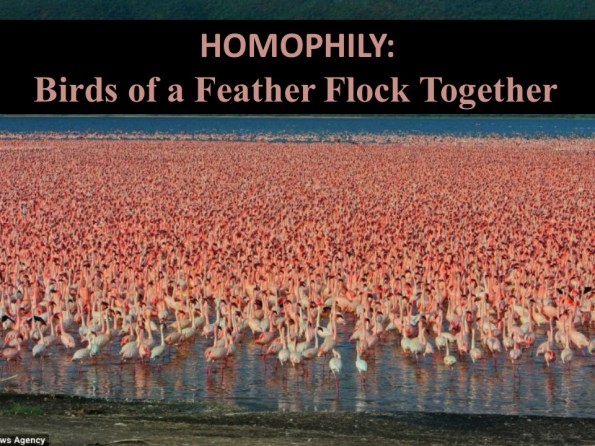
Sociologists use a term for describing the tendency of people to associate with other people like themselves: homophily. The familiar phrase “Birds of a feather flock together” aptly describes this preference. But the tendency of racial groups to congregate in particular communities arises from motives beyond homophily. The practicality of particular cultural resources (religious centres or ethnic grocery stores) or proximity to those who share a common language . In extreme cases ethnic or racial groups may congregate out of safety concerns.

Yet the fundamental mission of the church demands that we cross ethnic, language and cultural barriers. We are sent “into all the world to make disciples”. (Matt. 28:19) The homogenous unit principle creates a false dichotomy between the work of missionaries and the work of the local church.

flamingo 02

The church is at it’s best when it demonstrates the love of God to all people. The more homogenous we make the local church the less inclusive we portray the kingdom of God. Consciously focusing on serving one particular population group that happens to look and sound like me, unconsciously excludes minority groups that look and eat differently from me.

Monocultural churches look a lot like the problem Paul confronted Peter over in Galatians 2:11-14. We share the Gospel with people of other races because that’s our mission, but we revert back to worshiping with the people and culture most familiar to us because that’s where we’re comfortable. I believe God constantly calls us out of our comfort zones to stretch us and to benefit people around us regardless of their degree of commonality. I thought this quote (from this blog) provided an excellent summary of my concerns:

The main criticism of the homogenous unit principle is that it denies the reconciling nature of the gospel and the church. It weakens the demands of Christian discipleship and it leaves the church vulnerable to partiality in ethnic or social conflict. It has been said that ‘the homogenous unit principles is fine in practice, but not in theory’!

The Homogenous Unit Principle (HUP) continues its life today because, thanks to homophily, it works. The theoretical breakdown also still exists because the HUP justifies passive racism.

Rather than embrace the fundamental missional example of the New Testament that the church must share the Gospel with disparate cultural and ethnic groups, HUP prioritises ministry based upon similarity.

Rather than celebrate the growth of the early church as it transitioned from its Jewish roots to include its Gentile neighbours, HUP avoids the struggle on the basis of effectiveness.

Rather than embodying the command to love our neighbours as ourselves, HUP encourages the church to love neighbours LIKE ourselves a little bit more than others.

Rather than promoting spiritual growth that overcomes prejudice and racial stereotyping HUP reinforces the supreme value of practical efficiency.

So the numbers produced by HUP may show a period of growth, but at what cost to the church as the embodiment of the Spirit of God.

Homophily may be a natural sociological phenomena.

I believe that God desires the church to redeem homophily by demonstrating an unnatural love for people who don’t look, sound, or live like “us”.

A time is coming and has now come when the true worshipers will worship the Father in the spirit and in truth, for they are the kind of worshipers that the father seeks.                    John 4:23

The Church’s Cultural Captivity

In my previous post I began a summary of a presentation by Dr Soong-Chan Rah that I recently attended at the Northeastern Seminary. In this post I will describe his second session.

What is Cultural Captivity?

“When the church looks more like surrounding culture than the values of Scripture, it has been taken captive.”

Dr Rah suggested three ways that Western/White culture has captured the church in America.

  1. Individualism;
  2. Materialism; and
  3. Racism.

Let’s look at these:

1. Individualism

Most Western Christians fail to appreciate that the Bible was written to communities. In the case of many Old Testament books the targeted audience was the nation of Israel. In some cases the prophets also wrote to the nations surrounding Israel. Likewise, the New Testament was predominantly written to entire churches. Even the pastoral books were included in the Bible because Timothy and Titus obviously shared them with the congregations they served.

Yet when we read Scripture we predominantly seek personal applications. We ask, “How does this passage speak to my circumstances, or improve my life?” rather than asking “How can this church better represent God to our immediate community and the world?”

Our individualistic mindset is demonstrated in 1 Corinthians 3:16: Do you not know that you are a temple of God and that the Spirit of God dwells in you? (NASB) Both the context and the plural Greek word make clear that this statement refers to the church, not the individual. This hasn’t prevented us from using this verse to support everything from prohibiting smoking to supporting dieting, etc. while completely missing the point that Christ dwells within his church.

Without going into details here, other cultures with a more communal worldview will more naturally value the spiritual health of the body, the church, rather than focusing upon individuals.

2. Materialism

This point extends beyond simply the pursuit of material goods. Rah proposes that our vocabulary often betrays how we have reduced life and relationships to an exchange of goods. Commerce becomes the lens through which we view and describe life. Consider this list of terms:

  • We invest in people.
  • We spend time.
  • We value or treasure  those we love.
  • We waste time.
  • We shop for churches.

You could probably come up with your own list.

Many churches also reflect a materialistic attitude. We commonly assess the health of a church using the ABC measuring stick: Attendance, Building, and Cash flow. Matthew 25 and Acts 2 both teach that spiritual health has nothing to do with these measures. Rather, Jesus seeks justice and compassion, love for the poor, dedication to God, and commitment to other believers.

If we accept these attitudes as symptoms of Cultural Captivity, then we need to open ourselves up to the possibility that we can learn from Christians and churches in other cultures.  This realisation challenges any sense of spiritual superiority we might have because of large ABC’s.

3. Racism

Although “race” is really a social construct to explain visual differences between groups of people, it has proved a major point of conflict throughout the history of the church. In the NT the divide between Jew and Gentile was at once cultural, racial, and spiritual. While it is too simplistic to view the Jew-Gentile conflict as purely racial, surely ethnic heritage played a significant part in creating that divide.

Acts 15 describes a major council within the first church to address significant questions about Jews, Gentiles and Jesus. Sadly, the church failed to embrace that lesson and has throughout history sought to exclude various racial groups from full membership in the body of Christ.

The rest of the book of Acts describes the power of the church to grow when we concentrate on the Spirit that binds us together rather than various aspects that differentiate us from one another.

American churches have allowed cultural values to validate the establishment and preservation of separate black and white churches throughout the country. Rather than embodying a lesson the first church learned 2000 year ago, we have lagged behind culture as we have resisted and devalued the racial integration of churches. We have maintained our racial islands while watching institutions throughout society integrate. In this instance churches are captive not just to culture, but to a culture of 30 years ago. In the meantime, society’s values in relation to race relations now often do a better job of reflecting Godly values than the church does.

Is there Hope?

A major empowering feature of Cultural Captivity is that it’s difficult to detect from the inside. With no other reference point we read Scripture through our cultural lens and it feels normal and logical.

My previous post demonstrated the “browning of America”. As a result of this demographic shift our cultural assumptions are challenged. We find ourselves exposed to alternative ways of reading and applying Scripture. Exposure to different cultural values should prompt us to reexamine our beliefs and practices for areas where western culture has skewed our reading of God’s Word. As we study the Bible, we need to listen to others who speak from a different cultural perspective. Not everything that is “obvious” to us is obvious to everyone. And sometimes what’s “obvious” may even be wrong.

Multiethnic churches have an opportunity to lead the US church  in this process of  self-examination. However, it still requires a commitment to raise, discuss and study topics that may lead us individually and as a church to uncomfortable places. Racial integration will lead to healthier churches, but it requires each of us to be willing to live with a degree of discomfort as we encourage each other on our journey toward Christ.


Changing Faces

many colorsEarlier this week I was fortunate to attend a workshop on Multicultural Churches presented by Dr Soong-Chan Rah at Northeastern Seminary here in Rochester, NY. Dr. Rah is widely recognised as a leading academic in the field of multiethnic churches. He has directly planted and ministered in a multiethnic church in Cambridge, MA and now teaches courses related to urban and multiethnic churches. In 2010 he published a popular book, Many Colors, advocating the need for churches and church leaders to understand the influence of culture and the need to develop Cultural Intelligence.

Over the next few weeks I plan to reflect on the material Dr. Rah presented at this workshop.

The Changing Face of Global Christianity

In 1900 83% of Christians were located in Europe and North America. These primarily white continents infused Christianity with values and practices that were meaningful to that population.

By 2050 sociologists project that a mere 28% of Christians will be located in Europe and North America. Even in these continents many of the churches will be predominantly filled with non-white members. For example, the largest church currently in Kiev, Russia is a Nigerian congregation.

Globally, God’s kingdom is growing, not shrinking. But the church of today and tomorrow looks very different from the church of yesteryear. By 2050 Africa will contain 29% of global Christians, Latin America will be home to 22% and Asia will have 20% of all Christians.

The forms and rituals of the predominantly white European church will also need to evolve to reflect this movement in global church demographics. Each of these cultures needs to find it’s individual voice with which to worship and serve God.

The Changing Face of American Christianity

As a result of immigration (legal and illegal) and birth-rate American society has changed dramatically since the 1960’s. In 2008 one-third of the American population were minorities of various backgrounds. By 2011 half of all births were within minority communities. At that rate, by 2023 one half of all children in the US will be racial minorities. As the trend continues, by 2042 the historically dominant white racial group will make up less than 50% of the US population.

Stephen Warner has observed, “The new immigrants represent not the de-Christianization of American society, but the de-Europeanization of American Christianity.” Elsewhere he noted,

Above all, the new immigrants make it decreasingly plausible for Americans to think of Christianity as a white person’s religion. . . . And although it may not be apparent in many congregations, American Christians are increasingly people of color.

There is no reason to think that this trend will reverse itself any time soon. Predominantly white churches will increasingly look like anomalies in this changing landscape. The question monocultural churches must address is whether they will embrace this racial diversification of Christianity, or resist it.

The Changing Face of Boston

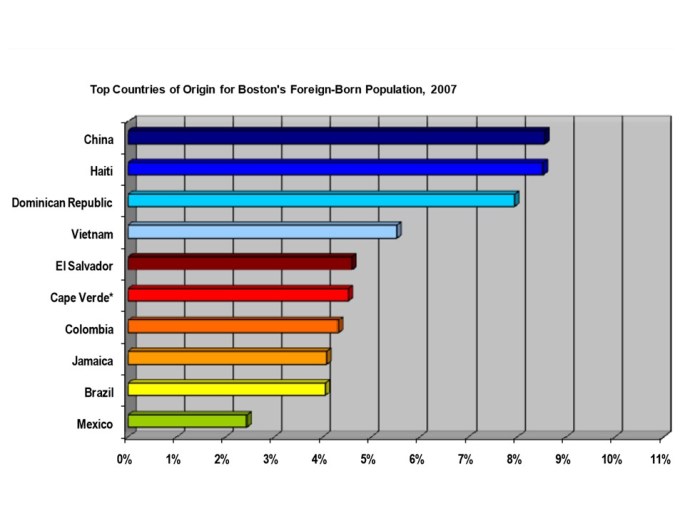
Dr Rah illustrated the transition the American church is experiencing by using Boston as a case study. New England has long been recognised as the prime example of increasing secularisation and diminishing Christian presence. However, Dr Rah contends that much of this decrease in church attendance is primarily predominantly located within the white portion of society.

In 1970 the city proper of Boston was home to about 300 churches. Many of these historic churches no longer exist. In most cases their buildings have been repurposed or demolished.

However, this does not mean that God has fled Boston. Dr Rah cited a recent survey that listed 600 churches within the city limits of Boston. The difference is that these churches do not meet in stately buildings on prominent street corners. The churches are mostly found within ethnic, immigrant communities, and over half these churches hold their services in a language other than English.

According to a 2009 report commissioned by the Mayor’s Office of New Bostonians, by 2007 minority racial groups made up a majority (50.1%) of the city of Boston’s population. The demise of most of those 300 churches was not tied to a decline in Christianity, but the churches failure to engage the highly spiritual immigrant and other minority communities.

Between 2001-06 at least 98 new churches were planted in Boston. 76 of these churches responded to survey and reported that while 50% of those new churches worship in a language other than English, many of them, even with a majority non-white attendance, also have English services.

The Christian world is changing. American society is changing. Our cities are changing.

The big question for established churches is, “Will existing churches allow God to infuse them with new life and cultures, or will God need to raise up new churches to continue his mission in the changing landscape of American cities.

Boston Immigration

Reading for Reconciliation

Today’s guest post is written by Bobby Valentine. Bobby is a minister currently serving God in Arizona. He is also a scholar who has co-authored several books in the field of church history and practice. Bobby writes a popular Bible study blog that I encourage you to check out: http://stonedcampbelldisciple.com/

Unlike previous reading lists posted on this blog Bobby’s list isn’t directly related to church ministry. However, I believe this list serves as a great example of how dialogue and inquest lead to transformation.


I grew up in north Alabama. My family’s roots come thru Florida and New York though.  My family was and is open to many things on a “personal” level regarding race.  But I did not know anything. I still do not but I am learning.  It was during my ministry in New Orleans that I came face to face with the matter of race as something beyond my imagination to comprehend.  This was a rather difficult discovery and one that I resented to be honest. But some folks actually helped open my eyes in a gentle but firm way.  This was 1995ish when I was challenged by a fellow by the name of Robert Birt to read Before the Mayflower … it was the beginning of a long journey.  Talking about race, I have learned, is an explosive issue for many.  It is a subject filled with defensiveness at the mere mention of it. But there is in fact a “history” and that history … like the history of our family of origin … has profound and not so subtle influence on every aspect of our lives in America.

As a Christian, I am certain that we have an obligation to move beyond our own personal experience and be God’s leaven in our world.  This redemptive MISSIONAL task is not easy.  The church has an obligation to deal with this and preachers and elders have one as well.  With that in mind I share the following list of books and movies that have helped me move out of my comfort zone.  Preachers often avoid the subject like the plague.  It is so much easier and safer to preach about something as profoundly relevant as instrumental music (!) … Yes I am being sarcastic but I cannot help myself.

Remember I am a White Italian Boy from Alabama. I make no pretense to being a scholar in this area.  These are just resources that have helped me in my own ministry as I try to live the Gospel of Reconciliation.  There is nothing on this list I have not read.  I began keeping this list in 1996 and have updated it on my pc thru the years.  I share it with you my friends and lovers of God’s shalom and grace …

Books

Lerone Bennett Jr, Before the Mayflower: A History of Black America (in many editions).  Bennett’s book is a classic and it was the beginning point for me.  It was the first book I read as noted above.  It immediately let me know there is way more to American history than I ever figured.  Bennett eloquently chronicles and interprets the African American experience in the USA. His book can help us get a grasp on the proud moments and the valleys of blacks in America.  This is a great book to begin your own journey of thinking and learning.

Edward J. Blume & Paul Harvey, The Color Christ: The Son of God and the Saga of Race in America.  What color was Jesus? It has mattered to many people through the years.  And how we have conceived him has impacted Christian practice and social ethics. We travel from slave huts to Hollywood in this excellent and compelling book.  Jesus has been hijacked for many an agenda in the racial sage of America.

Taylor Branch, Parting the Waters: America in the King Years, 1954-63; Pillar of Fire: America in the King Years, 1963-65; At Canaan’s Edge: America in the King Years, 1965-68.   These three volumes by Branch are the most extensive material on the struggles that wracked America in that long decade or so from Rosa Parks to the death of Martin Luther King Jr.  How American changed in those years!  My own question was after reading these breathtaking volumes was … Lord have mercy on your church and so how can we move forward.  These are great books.  They are not small but they are easy to read.  Branch is a great writer. Branch won Pulitzers for his work.

James Cone, Black Theology & Black Power.  This was my introduction to Cone. Cone makes me squirm.  He is in your face and he rubbed me raw I confess.  I cannot tell you how many times I threw that book down.  He made me mad and I think he wanted to! However I am glad I read it and I am better for it.  He helped me understand something of anger and that I should be angry about how some things have been and remain.  Do we use the Gospel and religion as a cloak to hide our complicity in racism?

James Cone, Martin & Malcolm & America: Dream or Nightmare. Cone’s style in this work is considerably different than in BT&BP. He is not dispassionate (not sure he is capable of that) but not as fiery.  But was America in the experience of these premier black leaders? How far apart are their visions of what we are and what we are to be.  This is a good book.

Tony Evans, Getting to Know One Another.  It is always good to see an Evangelical write about the subject of racial reconciliation.  Evans has great respect for the Bible and he walks a fine line of not trying to radically offend white folks he is writing too.  This is a good books to give to the highly sensitive but he will actually convict us if we let him.  The Bible is not silent on this matter.

Michael Casey, Saddlebags, City Streets & CyberSpace: A History of Preaching in Churches of Christ.  This book is not on race relations per se.  But Casey includes an insightful chapter on African American preaching among “us” as represented by Marshall Keeble especially.  How did Keeble address the issue and did he at all?  Casey suggests that Keeble used “coded” language that said something to Whites and another thing to Blacks.  It reminds me of the movie “White Men Can’t Jump” when Wesley Snipes says to Woody Harrelson’s character “YOU CAN’T HEAR JIMI!!”  Its true … sometimes we do not have ears to hear.  Good material on G. P. Bowser and R. N. Hogan too.

Tom Dent, Southern Journey: A Return to the Civil Rights Movement.  This is probably one of the better introductions to this turbulent period for a White Italian Alabama boy.  It was a good read.  It is filled with human interest stories.  Reading this book originally in 1998 I recall saying to myself, “ive been there! and I didn’t know that!”  This along with Bennett is a good “entre” into the waters.

Frederick Douglass, Narrative of the Life of Frederick Douglass.  I have long championed the agenda of recognizing FD as one of the Founding Fathers of America.  This book is small, heroic and disturbing.  Some folks have idealized visions of slavery and nothing is worse than perpetuating these images than Gone with the Wind (a book I have come to despise).  The defining moment in FD’s life was when he was 19 or 20 he refused to submit to a beating and he fought back.  It was his declaration of independence. His fiery passion for liberty and justice fill his narrative. This book should be required reading in high school.

Eric Foner, Forever Free: The Story of Emancipation & Reconstruction.  Foner is one of the foremost scholars on the Reconstruction period.  This lively work draws from newspapers, sermons, corporate advertisements, art, even the circus! It scattered among it brief “Visual Essays” because seeing a pictures are worth a thousand words and these are worth millions.  The story that we share is the tragedy of willfully selling out for the sake of filthy lucre a race of people that brought Reconstruction to an end.  And there are PLENTY of MYTHS about reconstruction that need to be burst.  Great book.

David J. Garrow, Bearing the Cross: Martin Luther King Jr and the Southern Christian Leadership Conference.  Garrow won a Pulitzer for this magnificent work.  It is marked by great prose, depth of understanding, and showing the continuing relevance of King and his legacy.

Fred D. Gray, Bus Ride to Justice: Autobiography of Fred Gray.  I first read Gray’s book in the late 1990s and a revised edition has since come out.  Gray is the quite “giant slayer” of the Civil Rights Movement.  Born and raised in Jim Crow Montgomery, he pursued a silent promise to “destroy all things segregated!” He defended Rosa Parks, orchestrated the Bus Protest of 1956, was MLK Jr’s attorney, he desegregated Alabama’s schools, the 1965 Selma march, the landmark Gomillion v. Lightfoot Supreme Court case and the Tuskegee Syphilis Study attorney.  Gray is a testimony of a man’s CHRISTIAN commitment to the Gospel of reconciliation and how one poor man defeated the system.  He is deeply committed to Christian education and a preacher of the Gospel.  He was one of Marshall Keeble’s “boys” … and preacher for the Tuskegee Church of Christ.

Martin Luther King, Jr, Testament of Hope: The Essential Writings of Martin Luther King, Jr. King is as powerful to read as he is to listen to. His passion for both peace and justice is contagious.  The importance of reading King is self evident in my opinion.  Nothing else needs to be said.

Malcolm X (with Alex Haley), The Autobiography of Malcolm X.  Reading Malcolm reminded me – yet again – how different some people’s experiences have been from mine.  What I got out of Malcolm is not only a sense of the deep seated nearly subliminal anger that exists in many quarters of the USA.  Malcolm helps me understand “why this is so.”  The second thing I get from Malcolm is how dangerous racism, and the inevitable injustice that comes with it, is to Christian faith and its witness.  Racism leads folks to declare Christianity a white man’s religion and this is why Malcolm embraces Islam.  Must read book.

Deirdre Mullane, editor, Crossing the Danger Water: Three Hundred Years of African-American Writing. This is an outstanding resource that I came across in the late 1990s.  It contains selections from slaves and freedman.  It has speeches by Frederick Douglass and Sojourner Truth, W.E.B. DuBois.  It contains government documents that will shock you. It has poetry and prose.  Truly a wide ranging and good resource.

Thomas Oden, How Africa Shaped the Christian Mind.  It is one of the biggest mistakes of the American mind – both white and black – to imagine Christianity as a EUROPEAN religion.  This is not the case.  Oden argues with deft command of the primary sources that in the first 1000 years of Christian history that the religion of Jesus was African and not European.  Many of the first commentaries and schools were established and written in Africa not Europe.  The rise of monasticism that played such a huge role in Christianity rose in Africa not Europe.  Some of the first decisions regarding the canon of Scripture were made in Africa not Europe.  This is a vastly important work for both white Christians and black Christians.  Get it and devour it.  Oden btw is one of the worlds leading Patristic scholars.

Harriet Beecher Stowe, Uncle Tom’s Cabin.  I recall hearing the derogatory term “Uncle Tom” thrown around growing up.  I had no understanding of what it meant though.  I have read UTC at least three times since 1995 and each time it has been a different book.  I was stunned first of all how compelling the work actually is. I learned the book is about far more than Uncle Tom and I learned that Uncle Tom is radically different than the stereotype I had encountered.  Tom is actually a powerful character in the book and far from a weakling. But there are slaves that would choose death willingly over slavery in the book.  There is discussion of biblical interpretation in the book.  It is no small wonder the book was burned on the campus of the University of Virgina when it was published and that it was banned in all the states that would become part of the Confederacy.  This is the book that saved the dying abolitionist movement and it was the most widely read book in America (after the Bible) in the 19th century.  It has a much going for it being the quintessential American novel as Tom Sawyer.  You should read it.

Sojourner Truth, Narrative of Sojourner Truth.  Truth does for women what Frederick Douglass did for the men.  Douglass was legendary for his eloquence but Truth has nearly prophetic gifts for speech.  She speaks not simply about racial justice but gender too.  Am I not a woman she asked once!? I was impoverished as a White Italian Alabama Boy before having her in my life.

Richard Wright, Native Son.  Wright is a great novelist but I just did not like his book.  The first time I read Native Son I actually hated it. It was so depressing.  It had communists in it.  I did not understand it.  I had no way of actually understanding what was going on in the book. The book released way back in 1940 reflects the inner hell of a black man of the time.  Something of this appear again in the Autobiography of Malcolm X. But as I have grown and matured and have gone thru some pretty interesting life experiences Native Son has a different feel to it.  Wright forces his readers to deal with the demons living inside at least one victim of Jim Crow.

Richard Wright, The Ethics of Living Jim Crow.  This small book was actually published earlier than Native Son but I did not read it until 2000.  I was interested in Wright because I was living in Mississippi and the work is set in MS.  It is an introduction to a world that I, as a white boy, was totally clueless to.  Reading this helps me see that there really have been two Americas … if not more.  Read this book if you dare.

Maryanne Vollars, The Ghosts of Mississippi: The Murder of Medgar Evars, the Trials of Byron De La Beckwith and the Haunting of the New South.  I read this book in 1996.  It won the National Book Award and was turned into a movie that I invited several folks at the church i was preaching at to go see.  It is set in the same area I lived.  It is a riveting account of the struggles for liberty and justice and righteousness in Mississippi. The White Citizens Council, the Sovereignty Commission, the “reign of terror” in the lives of people. This is a compelling book and a window into our common story.

Booker T. Washington, Up From Slavery.  This is a classic from the man from Tuskegee.  His struggle for freedom, dignity, the struggle for education.  It is good to read BTW and W.E.B. DuBois because it shows us that “black people” are no more monolithic than “white people.”  We have these stereo types that just because a person is “black” that they think so and so when there has been as much diversity of thought among “them” as there has been among “us.”   That is confirmation that we are all just … PEOPLE!!

Films

There are numerous films/movies that have helped me move from an intellectual engagement with this issue to an emotional one.  Movies are powerful media that can be used to effect change within us if we are open to them.  I am not commenting on these movies as a movie critic, historian or any thing else.  I am commenting on them as a White Italian Alabama boy and the effect they had upon me.  Not all had the same impact upon me.  But each has opened my eyes and my heart to something of our shared story here in America.  I will simply list the title and who made it or starred in it.  I have never forgotten any of these films … some folks are so fixed on their like or dislike of certain actor they can not open their minds to the film … dont be like that …

  • Mississippi Burning (Tom Cruise and Gene Hackman)
  • The Ghosts of Mississippi (Alec Baldwin & Whoopi Goldberg)
  • White Man’s Burden (John Travolta & Harry Bellafonte) movie engages in brilliant “role reversal” to powerful effect
  • A Time to Kill (Samuel L. Jackson)
  • Roots (adaptation of Alex Haley’s epic)
  • Rosewood (true story of the massacre of a black community in Florida)
  • Amistad (a Stephen Spielberg film)
  • Buffalo Soldiers (Danny Glover)
  • Tuskegee Airmen (story of Benjamin O. Davis Jr)
  • The Color Purple (Oprah Winfrey)
  • When We Were Colored
  • Planet of the Apes (a brilliant parable about race relationship in America without people even knowing it (see http://www.movieprop.com/tvandmovie/PlanetoftheApes/racial2.htm )
  • To Kill a Mockingbird (classic based on Harper Lee’s novel)
  • Spike Lee routinely deals with the black experience in America.  Films such as “Four Little Girls” and “Malcolm X.”
  • The Butler (Forest Whitaker)

This list does not even attempt to be comprehensive of either books or films.  Rather these are materials that since the mid 1990s have had an impact on me.  They have made me more sensitive to things than before.  They have changed my preaching and hopefully my living.  Part of learning to love is learning about your neighbor.   I am not nearly as defensive as I used to be on this matter … now I just pray and pray for God’s new creation to be a reality in his church.


Do you have some suggested reading that you’ve found helpful as you navigate different cultures that you can add to this list?


 

Color Brave not Blind

This week a friend shared a TED talk with me that captured my attention. Mellody Hobson raises the issue of race because as she looks around the boardrooms of corporate America she sees a glaring absence of minority representation. Consider this statement, “Of the Fortune 250, there are only seven CEOs that are minorities, and of the thousands of publicly traded companies today, thousands, only two are chaired by black women, and you’re looking at one of them.

This disparity prompted her to take the risk to use the forum of TED talks to discuss the state of race equality in the United States. She speaks to the business community and challenges them not to be complacent and to take whatever small steps they can to provide all people with the same opportunities in life.

Here is her presentation from March 2014.

I appreciate her use of the term “color brave”. It encapsulates several important ideas.

  1. Addressing racial issues still requires courage.
  2. The phrase promotes action. No bravery is required to say nothing.
  3. It challenges the common term, “color blind”.

I’m not going to regurgitate her excellent presentation, but I do believe churches need to adopt this attitude. I believe that color blindness is the predominant attitude toward racial integration in the majority of churches and it results in a lot of white folks standing around together, and a lot of black folks standing around together, and lot of Hispanic folks….

I was also blessed this week to attend a Gospel Meeting at a local black Church of Christ. The visiting speaker was Dr Carl Baccus from the Southside Church of Christ in Los Angeles. Dr Baccus has ministered with this church he planted for the past 58 years.

At one point during his sermon, Dr Baccus paused, looked around and said, “This church is too black.” That’s a “color brave” statement if ever I heard one!!! He then made the point that churches need to serve their communities and therefore look like their communities.

His own church was planted in a predominantly African-American neighbourhood not far from LAX. However, over the years this neigbourhood has transitioned and now is now predominantly Hispanic. Southside Church of Christ responded to this change by hiring a Hispanic minister. They offer a Spanish language worship service and Bible classes as well as bilingual portions of their services.

Dr Baccus also mentioned that more Koreans are moving into the neighbourhood now and the church is considering how this will impact their ministries.

When Dr Baccus said, “This church is too black” he spoke with considerable credibility as someone willing to change the culture of his church in order to reach the lost souls in his community. That’s being “Color Brave”.

What will it take for more church leaders to look their congregation in the eye and say, “We’re too monotone. Let’s do something about it!

  • I have previously written on the topic of racial colour blindness HERE.

The History of Race Relations in the Church of Christ

I just finished reading a short book by Daniel Blankeship that I encourage you to read. It’s lengthy title is Race Relations in the Church of Christ During the Civil Rights Movement.

Daniel does a good job of describing the racial tensions endemic within churches of Christ in the 1960’s. The book was first written as a course requirement at Harding School of Theology. As a consequence it is well footnoted and has a helpful bibliography for anyone wanting to study the topic further.

As I read the book I kept asking myself, “How does this historical information impact me now?” The answer I came up with revolves around reconciliation.

The first step in any process of reconciliation requires acknowledging problems. It’s my experience that many churches today want to act as though there is no problem. Many Christians seem quite content to have both black and white churches existing in the same towns all over the country. Blankenship points out the problems with this arrangement,

Many white Christians believed their duty to the black church was to provide them with finances for a building, yet few white Christians desired authentic relationships with their black brethren. Perhaps providing a building to the black Christians was a way of segregating the church in an non-threatening way. Whites could claim to abhor racial prejudice and offer [financial] support to black churches, preachers and schools, even while maintaining segregated colleges in the South and generally ignoring the discrimination against blacks in economics, education, politics and social customs. White churches made sure that their black brothers ans sisters had separate places to worship.

When Christians and whole churches deny that racial tension has ever been a significant issue among Churches of Christ they are incapable of taking the first step toward reconciliation.

Just as our eternal salvation requires repentance for sin so that we can reconcile with God, personal and racial reconciliation also begins with confession and repentance.

In 1999 Abilene Christian University demonstrated what this confession and repentance look like when they publicly apologised to the African-American churches of Christ for the many years in which they excluded black men and women from their student body. (You can read more of this apology HERE.) Lipscomb University in Nashville has also gone through the process of confession and repentance as it builds bridges to the African-American churches in the region. (This process is well described HERE.)

I highlight these universities because, as Blankenship demonstrates, for so long they stood as icons for the racial segregation and discrimination that existed among churches. Their steps to reconcile with the black churches provide an important model for congregations around the country.

I don’t know that each and every congregation must have a special event to apologise to their African-American community for actions taken in the 1960’s. However churches must have enough familiarity with their own history and the history of Churches of Christ in general to acknowledge injustice when appropriate. The “appropriate” time may be in personal conversations, or during decision making processes, or maybe just slipped into a sermon from time to time. Pretending the Churches of Christ have never had any problems between racial groups is simply not an option.

I encourage you to take an hour and read Daniel’s book. It’s a good introduction to the historical issues confronting the church. For $5 how can you go wrong? You can purchase it HERE.
If you’re looking for a more complete study of the topic then Wes Crawford’s book “Shattering the Illusion“, might help you out.

The Value of Community

Last week’s post on Donald Sterling was well received. Thank-you to those who took the time to read it and also to those who sent me a private message on the subject.

I wrote that post just a couple of days after the NBA gave Sterling a lifetime suspension from the NBA. I’m happy with my comments and questions. But I appreciate a couple of friends who have written on the topic this week and the perspectives that they present. No one person or article can cover all aspects of any topic and each writer has a style that connects best with different audiences. So I accept my limitations, but look at this for a diverse lineup:

  • I write as an Australian who has spent most of the last 15 years in the US. I now life in upstate New York.
  • Jonathan Storment has white skin, was raised in Arkansas and now preaches for a church in Abilene, Texas.
  • Sean Palmer is an African-American raised in the deep South. He now serves as the Lead Minister at The Vine church in Temple, Texas.

You get enough of my writing on this site, so I want to use this space to highlight some elements of recent articles by Jonathan and Sean.

Jonathan’s article is one of his regular guest posts on Scot McKnight’s blog.  He opens and closes by racist attitudes in his life. The point of his article is that the church has helped him identify this sin and repent of it. Without this outside intervention in his life these attitudes may still remain unacknowledged and festering. Praise God for those in his life who were not too timid to speak truth. Too often we gather around us people who affirm us more than challenge us. While we certainly need affirmation and encouragement a healthy church will also help us identify blind spots in our hearts and lives.

Jonathan used one term that really caught my attention: “Elegant Racism”. While it’s hardly self-explanatory it accurately describes many of our churches today. On the one hand we confess that God loves all people of all races, all ethnicities, all  cultures, and all languages equally. But we take no steps to build bridges to the racial, ethnic, cultural and language groups different from our own. We are “elegantly racist” because we’re so darn polite about not associating with the “others”!

The sad truth is that it’s often easier to love people who aren’t sitting in our living room. It’s easy to be moved about the plight of poor children on the other side of the world and give lots of money to send a missionary so that they can hear the wonderful news of Jesus. It’s much harder to run an after school program for children on the other side of town.

Jonathan’s article is a needed reminder for me. Too often I get to the end of a week and look back on who I ate with and realise they were mostly, or all, white guys aged within 15 years either side of me. If I’m not intentional, elegant racism becomes a tragic part of my life. Who are your friends? Who do you eat with? Who do you go to the movies with? What activities in your life take you outside your cultural comfort level?

Sean’s article points out three ways our Sunday segregation undermine central tenets of the Gospel. First, we make cultural preservation a ministry of the church. Although Romans 16:4 has a puzzling mention of “all the churches of the Gentiles” the first church consistently worked to overwhelm the Jew – Gentile divide. When churches make the preservation of a particular culture part of their mission, we begin diluting the Gospel message.

Second, when our racial traits form a stronger bond than does our submission to Jesus we undermine Jesus’ death. Sean makes this excellent point, “Because we have deluded the scriptures and encased the Bible as a personal, self-help book, we’ve lost its deliberately public calls for social change.” Yes, we can make our faith too personal.

Sean’s third point naturally flows from his second. Not only is our faith too personal, so is our worship. The church is infatuated with worship styles. I’m part of that. I’m a big believer that worship needs to be meaningful to me in order to be meaningful to God. Singing hymns from the 1600’s with words I don’t understand prompts a disinterested attitude that disrespects God. But when we worship as a church we also practice sacrifice. We worship God when we sacrifice some of our preferences so that a sister or brother can express their heart to God.

I’ve recently been challenged to consider my entire Christian walk as one of submission. It’s tough. Ephesians 5:22 is an infamous verse as it instructs wives to submit to their husbands. If I’m asked to read this passage at a wedding I always make sure I read v21 “Submit to one another out of reverence for Christ.” This certainly provides a great basis for marriage. What we often overlook is that this passage discusses marriage as a metaphor of Christ and the church (v32). Mutual submission is the basis of harmony within the church.

When I’m unable to worship God because of “style”, I’m also not submitting to my sisters for whom that style has great familiarity and meaning. But if other church members refuse to vary their worship style they’re also refusing to serve those in the church with values different to themselves. God’s model of worship requires submission and sacrifice by everyone, not just the minority.

Summary

I hope my reflections have encouraged you. Most of all, I hope my post encourages you to go and read what these guys have to say. I really appreciate their hearts and the authenticity they bring to the table from their distinct backgrounds. Leave a comment on their blogs and support them as they stick their necks out to challenge the church to represent God’s vision for his kingdom: that the church may be one.

3 Lessons on Racism that Churches can Learn from Donald Sterling

On Saturday a recording surfaced of a conversation between the owner of the NBA’s LA Clippers, Donald Sterling, and his girlfriend. This recording contained some very racist comments made my Sterling. It wasn’t that he was calling people names, but his distaste for African-Americans was clear. For instance, he told his girlfriend that he didn’t want her bringing her black friends to Clippers games.

On Tuesday the NBA commissioner announced that he was suspending Donald Sterling from the NBA for life, and fining him 2.5 million dollars. He also believed that the other owners would vote to force Sterling to sell the team. (This article contains a good summary of these events.)

This is not a sports blog. In this post I don’t intend to analyze whether or not this incident has been handled correctly. Here are 3 lessons I believe churches can learn from this mess.

1. Racism is a Big Deal.

Many churches across America ignore racial division in the church. The vast majority churches can be described as black, or white, or Asian, or Hispanic, etc. Remarkably few churches have a membership that matches the demographics of their community. Most churches are unwilling to take steps to change the racial and cultural mix of their congregation.

The lack of urgency regarding the racial mix of churches across America is jarring. Contrast this ambivalence with the urgency the NBA players showed in their response to Donald Sterling’s comments. They were willing to boycott playoff games if they believed the response of the league was inadequate.

Perhaps we get comfortable sitting in our familiar buildings looking at familiar faces. Perhaps we lose sight of attitude shifts in the broader society. But this incident and the immediate public and player backlash demonstrate that today racism is a big issue with very little tolerance for those spewing hate.

While I certainly don’t imagine any churches I know would issue statements like those Sterling made, the lesson to absorb is that we cannot overlook the messages we project regarding race relations because this is a big deal.

2. There are No Excuses.

When this story first broke on Saturday I heard a few comments along the lines of, “Sterling is 81. He’s an old man and his statements reflect the values of the society in which he was raised. We should just fine him and get on with the playoffs.” The ensuing public furor quickly made that approach indefensible.

Churches have many members that lived through the civil rights turmoil of the 1960’s. In predominantly white churches many of these members and their families were opposed to the reforms sought by the civil rights movement.

Today most of these same people love their multicultural neighbours just as God does. But many churches also harbour people who, like Sterling, continue to speak negatively of other races. They may not express these thoughts publicly, but they express them around the dinner table when they see another Mexican restaurant open in town.

I know that we have people in our churches who often passively project a message saying, “I don’t mind if you have black friends at school or work, but don’t bring them to my church.” Churches don’t place signs on the street saying “Minorities Unwelcome”, but neither do most churches communicate the message that minorities will be welcomed.

Some people will say that Sterling shouldn’t be punished for comments he made in the privacy of his own home.

When it comes to God we don’t have any privacy. We can’t make the excuse that although I think racist thoughts and don’t trust or welcome anyone representing a different culture, I’m not a racist because I don’t act badly toward them.

God’s standard is not whether we act badly toward those of other cultures. God’s standard asks us whether or not we love them! 1 John 4:20 won’t allow us to compartmentalise our lives between the way we view the Creator and his Creation, “If someone says, “I love God,” but hates a Christian brother or sister, that person is a liar; for if we don’t love people we can see, how can we love God, whom we cannot see?

When it comes to racism, there are NO excuses!

3. Racism Contaminates Everyone It Touches.

Did you notice how quickly the NBA started the process for removing Sterling’s association with the league? Within four days of the recording becoming public he can no longer enter team premises or attend NBA games, even though he owns the team!

This can potentially be a tough lesson for churches to implement. Churches are filled with sinful people making a journey toward God. Christians bring many sinful habits and attitude to church with us. It is quite possible that someone who attends a wonderful church could make racially insensitive, or even hateful, comments. This will inevitably reflect upon the church. However, churches need to view instances of racism as severe sins and spiritual immaturity. We need to actively work to transform those attitudes into those closer to God’s heart.

For this reason churches must make clear statements about God’s view of race relations. We must articulate that God loves all races and cultures. We recognise and acknowledge the differences between us. We value the diversity of our society as a gift that gives us new eyes through which to see and experience God.

When churches establish a culture that respects ethnic diversity, our community will be much more likely to view isolated insensitivities and statements as not representative of the church and God.  But if churches fail to make clear positive statements regarding the importance of racial harmony our community will clearly hear us making a negative statement.

If you have some additional ideas of ways churches can learn from these recent events, please continue the conversation by leaving a comment.