Changing Faces

many colorsEarlier this week I was fortunate to attend a workshop on Multicultural Churches presented by Dr Soong-Chan Rah at Northeastern Seminary here in Rochester, NY. Dr. Rah is widely recognised as a leading academic in the field of multiethnic churches. He has directly planted and ministered in a multiethnic church in Cambridge, MA and now teaches courses related to urban and multiethnic churches. In 2010 he published a popular book, Many Colors, advocating the need for churches and church leaders to understand the influence of culture and the need to develop Cultural Intelligence.

Over the next few weeks I plan to reflect on the material Dr. Rah presented at this workshop.

The Changing Face of Global Christianity

In 1900 83% of Christians were located in Europe and North America. These primarily white continents infused Christianity with values and practices that were meaningful to that population.

By 2050 sociologists project that a mere 28% of Christians will be located in Europe and North America. Even in these continents many of the churches will be predominantly filled with non-white members. For example, the largest church currently in Kiev, Russia is a Nigerian congregation.

Globally, God’s kingdom is growing, not shrinking. But the church of today and tomorrow looks very different from the church of yesteryear. By 2050 Africa will contain 29% of global Christians, Latin America will be home to 22% and Asia will have 20% of all Christians.

The forms and rituals of the predominantly white European church will also need to evolve to reflect this movement in global church demographics. Each of these cultures needs to find it’s individual voice with which to worship and serve God.

The Changing Face of American Christianity

As a result of immigration (legal and illegal) and birth-rate American society has changed dramatically since the 1960’s. In 2008 one-third of the American population were minorities of various backgrounds. By 2011 half of all births were within minority communities. At that rate, by 2023 one half of all children in the US will be racial minorities. As the trend continues, by 2042 the historically dominant white racial group will make up less than 50% of the US population.

Stephen Warner has observed, “The new immigrants represent not the de-Christianization of American society, but the de-Europeanization of American Christianity.” Elsewhere he noted,

Above all, the new immigrants make it decreasingly plausible for Americans to think of Christianity as a white person’s religion. . . . And although it may not be apparent in many congregations, American Christians are increasingly people of color.

There is no reason to think that this trend will reverse itself any time soon. Predominantly white churches will increasingly look like anomalies in this changing landscape. The question monocultural churches must address is whether they will embrace this racial diversification of Christianity, or resist it.

The Changing Face of Boston

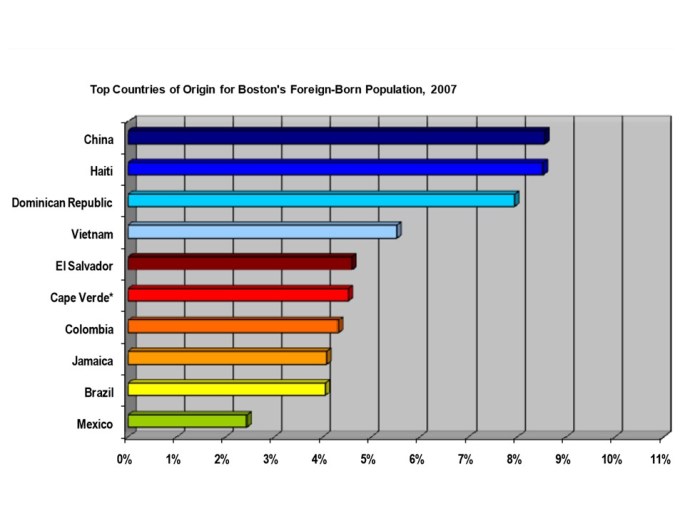
Dr Rah illustrated the transition the American church is experiencing by using Boston as a case study. New England has long been recognised as the prime example of increasing secularisation and diminishing Christian presence. However, Dr Rah contends that much of this decrease in church attendance is primarily predominantly located within the white portion of society.

In 1970 the city proper of Boston was home to about 300 churches. Many of these historic churches no longer exist. In most cases their buildings have been repurposed or demolished.

However, this does not mean that God has fled Boston. Dr Rah cited a recent survey that listed 600 churches within the city limits of Boston. The difference is that these churches do not meet in stately buildings on prominent street corners. The churches are mostly found within ethnic, immigrant communities, and over half these churches hold their services in a language other than English.

According to a 2009 report commissioned by the Mayor’s Office of New Bostonians, by 2007 minority racial groups made up a majority (50.1%) of the city of Boston’s population. The demise of most of those 300 churches was not tied to a decline in Christianity, but the churches failure to engage the highly spiritual immigrant and other minority communities.

Between 2001-06 at least 98 new churches were planted in Boston. 76 of these churches responded to survey and reported that while 50% of those new churches worship in a language other than English, many of them, even with a majority non-white attendance, also have English services.

The Christian world is changing. American society is changing. Our cities are changing.

The big question for established churches is, “Will existing churches allow God to infuse them with new life and cultures, or will God need to raise up new churches to continue his mission in the changing landscape of American cities.

Boston Immigration

The Value of Community

Last week’s post on Donald Sterling was well received. Thank-you to those who took the time to read it and also to those who sent me a private message on the subject.

I wrote that post just a couple of days after the NBA gave Sterling a lifetime suspension from the NBA. I’m happy with my comments and questions. But I appreciate a couple of friends who have written on the topic this week and the perspectives that they present. No one person or article can cover all aspects of any topic and each writer has a style that connects best with different audiences. So I accept my limitations, but look at this for a diverse lineup:

  • I write as an Australian who has spent most of the last 15 years in the US. I now life in upstate New York.
  • Jonathan Storment has white skin, was raised in Arkansas and now preaches for a church in Abilene, Texas.
  • Sean Palmer is an African-American raised in the deep South. He now serves as the Lead Minister at The Vine church in Temple, Texas.

You get enough of my writing on this site, so I want to use this space to highlight some elements of recent articles by Jonathan and Sean.

Jonathan’s article is one of his regular guest posts on Scot McKnight’s blog.  He opens and closes by racist attitudes in his life. The point of his article is that the church has helped him identify this sin and repent of it. Without this outside intervention in his life these attitudes may still remain unacknowledged and festering. Praise God for those in his life who were not too timid to speak truth. Too often we gather around us people who affirm us more than challenge us. While we certainly need affirmation and encouragement a healthy church will also help us identify blind spots in our hearts and lives.

Jonathan used one term that really caught my attention: “Elegant Racism”. While it’s hardly self-explanatory it accurately describes many of our churches today. On the one hand we confess that God loves all people of all races, all ethnicities, all  cultures, and all languages equally. But we take no steps to build bridges to the racial, ethnic, cultural and language groups different from our own. We are “elegantly racist” because we’re so darn polite about not associating with the “others”!

The sad truth is that it’s often easier to love people who aren’t sitting in our living room. It’s easy to be moved about the plight of poor children on the other side of the world and give lots of money to send a missionary so that they can hear the wonderful news of Jesus. It’s much harder to run an after school program for children on the other side of town.

Jonathan’s article is a needed reminder for me. Too often I get to the end of a week and look back on who I ate with and realise they were mostly, or all, white guys aged within 15 years either side of me. If I’m not intentional, elegant racism becomes a tragic part of my life. Who are your friends? Who do you eat with? Who do you go to the movies with? What activities in your life take you outside your cultural comfort level?

Sean’s article points out three ways our Sunday segregation undermine central tenets of the Gospel. First, we make cultural preservation a ministry of the church. Although Romans 16:4 has a puzzling mention of “all the churches of the Gentiles” the first church consistently worked to overwhelm the Jew – Gentile divide. When churches make the preservation of a particular culture part of their mission, we begin diluting the Gospel message.

Second, when our racial traits form a stronger bond than does our submission to Jesus we undermine Jesus’ death. Sean makes this excellent point, “Because we have deluded the scriptures and encased the Bible as a personal, self-help book, we’ve lost its deliberately public calls for social change.” Yes, we can make our faith too personal.

Sean’s third point naturally flows from his second. Not only is our faith too personal, so is our worship. The church is infatuated with worship styles. I’m part of that. I’m a big believer that worship needs to be meaningful to me in order to be meaningful to God. Singing hymns from the 1600’s with words I don’t understand prompts a disinterested attitude that disrespects God. But when we worship as a church we also practice sacrifice. We worship God when we sacrifice some of our preferences so that a sister or brother can express their heart to God.

I’ve recently been challenged to consider my entire Christian walk as one of submission. It’s tough. Ephesians 5:22 is an infamous verse as it instructs wives to submit to their husbands. If I’m asked to read this passage at a wedding I always make sure I read v21 “Submit to one another out of reverence for Christ.” This certainly provides a great basis for marriage. What we often overlook is that this passage discusses marriage as a metaphor of Christ and the church (v32). Mutual submission is the basis of harmony within the church.

When I’m unable to worship God because of “style”, I’m also not submitting to my sisters for whom that style has great familiarity and meaning. But if other church members refuse to vary their worship style they’re also refusing to serve those in the church with values different to themselves. God’s model of worship requires submission and sacrifice by everyone, not just the minority.

Summary

I hope my reflections have encouraged you. Most of all, I hope my post encourages you to go and read what these guys have to say. I really appreciate their hearts and the authenticity they bring to the table from their distinct backgrounds. Leave a comment on their blogs and support them as they stick their necks out to challenge the church to represent God’s vision for his kingdom: that the church may be one.

3 Lessons on Racism that Churches can Learn from Donald Sterling

On Saturday a recording surfaced of a conversation between the owner of the NBA’s LA Clippers, Donald Sterling, and his girlfriend. This recording contained some very racist comments made my Sterling. It wasn’t that he was calling people names, but his distaste for African-Americans was clear. For instance, he told his girlfriend that he didn’t want her bringing her black friends to Clippers games.

On Tuesday the NBA commissioner announced that he was suspending Donald Sterling from the NBA for life, and fining him 2.5 million dollars. He also believed that the other owners would vote to force Sterling to sell the team. (This article contains a good summary of these events.)

This is not a sports blog. In this post I don’t intend to analyze whether or not this incident has been handled correctly. Here are 3 lessons I believe churches can learn from this mess.

1. Racism is a Big Deal.

Many churches across America ignore racial division in the church. The vast majority churches can be described as black, or white, or Asian, or Hispanic, etc. Remarkably few churches have a membership that matches the demographics of their community. Most churches are unwilling to take steps to change the racial and cultural mix of their congregation.

The lack of urgency regarding the racial mix of churches across America is jarring. Contrast this ambivalence with the urgency the NBA players showed in their response to Donald Sterling’s comments. They were willing to boycott playoff games if they believed the response of the league was inadequate.

Perhaps we get comfortable sitting in our familiar buildings looking at familiar faces. Perhaps we lose sight of attitude shifts in the broader society. But this incident and the immediate public and player backlash demonstrate that today racism is a big issue with very little tolerance for those spewing hate.

While I certainly don’t imagine any churches I know would issue statements like those Sterling made, the lesson to absorb is that we cannot overlook the messages we project regarding race relations because this is a big deal.

2. There are No Excuses.

When this story first broke on Saturday I heard a few comments along the lines of, “Sterling is 81. He’s an old man and his statements reflect the values of the society in which he was raised. We should just fine him and get on with the playoffs.” The ensuing public furor quickly made that approach indefensible.

Churches have many members that lived through the civil rights turmoil of the 1960’s. In predominantly white churches many of these members and their families were opposed to the reforms sought by the civil rights movement.

Today most of these same people love their multicultural neighbours just as God does. But many churches also harbour people who, like Sterling, continue to speak negatively of other races. They may not express these thoughts publicly, but they express them around the dinner table when they see another Mexican restaurant open in town.

I know that we have people in our churches who often passively project a message saying, “I don’t mind if you have black friends at school or work, but don’t bring them to my church.” Churches don’t place signs on the street saying “Minorities Unwelcome”, but neither do most churches communicate the message that minorities will be welcomed.

Some people will say that Sterling shouldn’t be punished for comments he made in the privacy of his own home.

When it comes to God we don’t have any privacy. We can’t make the excuse that although I think racist thoughts and don’t trust or welcome anyone representing a different culture, I’m not a racist because I don’t act badly toward them.

God’s standard is not whether we act badly toward those of other cultures. God’s standard asks us whether or not we love them! 1 John 4:20 won’t allow us to compartmentalise our lives between the way we view the Creator and his Creation, “If someone says, “I love God,” but hates a Christian brother or sister, that person is a liar; for if we don’t love people we can see, how can we love God, whom we cannot see?

When it comes to racism, there are NO excuses!

3. Racism Contaminates Everyone It Touches.

Did you notice how quickly the NBA started the process for removing Sterling’s association with the league? Within four days of the recording becoming public he can no longer enter team premises or attend NBA games, even though he owns the team!

This can potentially be a tough lesson for churches to implement. Churches are filled with sinful people making a journey toward God. Christians bring many sinful habits and attitude to church with us. It is quite possible that someone who attends a wonderful church could make racially insensitive, or even hateful, comments. This will inevitably reflect upon the church. However, churches need to view instances of racism as severe sins and spiritual immaturity. We need to actively work to transform those attitudes into those closer to God’s heart.

For this reason churches must make clear statements about God’s view of race relations. We must articulate that God loves all races and cultures. We recognise and acknowledge the differences between us. We value the diversity of our society as a gift that gives us new eyes through which to see and experience God.

When churches establish a culture that respects ethnic diversity, our community will be much more likely to view isolated insensitivities and statements as not representative of the church and God.  But if churches fail to make clear positive statements regarding the importance of racial harmony our community will clearly hear us making a negative statement.

If you have some additional ideas of ways churches can learn from these recent events, please continue the conversation by leaving a comment.

May I Vent?

I am enough of a sports fan that I also publish a christian sports blog. As an Australian football fan I’ve been poking around their league website as the season is just starting. As I poked around I immediately noticed two articles (here and here) related to promoting multiculturalism in the sport and tolerance in our society.

Look at the vision and resources dedicated to this program described in this quote,

The AFL is pleased to announce 183 multicultural community leaders from around Australia will join the AFL Multicultural Community Ambassador program in 2014.

The aim of the AFL Multicultural Community Ambassador Program is to further engage multicultural communities in Australian football through a network of dedicated volunteers… representing 44 countries of birth, 65 nationalities and around 100 languages.

So here’s my vent…

How can a football league recognise the value of racial and ethnic diversity to its future growth while many Christians complain that the complexion of their neighbourhood has changed?

How can a football league proactively recruit and train “lay people” to spread the good news about football within their communities, while the answer most churches have is to start a new church for the new people?

How can it seem so normal for a football league to celebrate cultural diversity and such a political statement for a church to do the same?

How can a football league possess greater passion in spreading its game to new people than the church has for spreading the message of new life in Christ?

Can you imagine the church recruiting and training 200 “ambassadors” representing 44 countries of birth, 65 nationalities and around 100 languages? Wouldn’t that be a dynamic workshop?!

A separate article describes how Essendon captain, Jobe Watson, joined the AFL’s multicultural ambassador program as “the token white guy”. The rest of the players in this program represent immigrant or aboriginal communities. So why would a white guy from the suburbs join? I love his answer,

How can you expect society to be inclusive if a proportion of society only think multiculturalism is the responsibility of people with multicultural backgrounds?

To build on being an inclusive game and being accessible to people from all different backgrounds, it’s important that someone who doesn’t have as diverse a multicultural background as others is interested and is part of the program.

Those two sentences carry a lot of weight when applied to the church. Unless people of all ethnic backgrounds willingly work together our churches and society will never change. It shouldn’t be about a minority or collection of minorities conducting a campaign. It shouldn’t be about the majority legislating a path forward. It should be about everyone being willing to talk and work together.

Why Did Jesus Choose a Samaritan?

Luke 10 contains Jesus’ Parable of the Good Samaritan. The basic message is that we are to love each person that crosses our path.

The parable Jesus told contains an additional message that we might easily rush by.

In the previous chapter (Luke 9) a Samaritan village refused to provide food and shelter for Jesus because he was traveling to Jerusalem. That sounds like prejudice at its finest. Jesus’ disciples then sought to return the favour as they asked if they could call down fire from heaven upon the village. Jesus rebuked them and walked on to another village.

good samaritan 01A little later when asked to answer the question “Who is my neighbour?” Jesus tells a story that contrasts the religious leaders of the day and a foreigner. If Jesus simply wanted to create a contrast for his story, he could have told the parable of the Good Undertaker, or the Good Tax Collector. He could have used any number of unclean or unwelcome characters from Jewish society. Instead, Jesus made his hero a Samaritan.

In choosing a Samaritan as his hero Jesus provided a subversive commentary on Jewish societal attitudes of the day. So if you think Jesus wouldn’t have anything to say about race relations in the US (or any other country) today, you’re wrong.

A significant message from this parable is that we are to love our neighbours that have black or white skin. We are to love those who speak English poorly, or not at all. Of course, none of us are racists. But there are some groups of people we don’t like very much.

  • The (white) suburbs don’t like when the (black) city starts spreading outward.
  • We complain aobut all the Indians in the call centers who we can’t understand.
  • We don’t like the (sometimes illegal) immigrants taking “our jobs”.
  • We don’t like the Asians we see driving around town in their nice cars. (Because they all drive Mercedes, right?)
  • We’re uncomfortable driving through neighbourhoods where the store signs are all in another language.

Maybe we don’t want to call down heavenly fire onto these people, but it would be a stretch to say that we love them.

Yesterday was Martin Luther King Jr Day. As a figurehead within the civil rights movement he played a pivotal role in bringing great transformation to this country. In his “I Have A Dream” speech he made the statement,

I have a dream, that one day, my four little children will live in a country where they will not be judged by the colour of their skin, but by the content of their character.

That’s a dream Jesus had for the world. Jesus dreamed of a kingdom defined not by ethnicity, but by character. It’s certainly a sentiment found in this parable. In verse 37 we find that the true neighbour is not identified by race, but as “The one who had mercy upon him.

We need to respect the colour of skin, and the riches of languages and cultures of other people. We also need to look beyond these traits to their heart needs and their character.

In The Parable of The Good Samaritan Jesus makes a subversive statement about race relations. “Samaritans are God’s people too.” It’s a message that retains its relevance in 2014.

MLK: In His Own Words

No one can deny that Marin Luther King Jr was a powerful orator. He has influenced American society as much as anyone in history. I am not as familiar with his teaching as I would like to be. As Martin Luther King Day approaches on January 20 I find it meaningful to remind myself of the battles he (and others) fought and the non-violent philosophy he pursued.

So here is a Meet the Press interview from 1965 in which he discusses the activities of the civil rights movement, beginning with the March from Selma.

There are a lot of notable quotes in this interview. Early on this one caught my attention, “We believe that unmerited suffering is redemptive.”  There’s a lot to think about there.

Was there a quote from this interview that engaged you?

Mandela: Reconciliation & Forgiveness

Rod Cullingworth is a white South African. After studying for ministry in the US he and his family returned to Cape Town, South Africa where they have planted several house churches. He shares here his impressions of the recently deceased Nelson Mandela. Thank-you Rod for sharing your experiences. [The name Madiba is Mandela’s African clan name.]

Living in South Africa has provided useful close-up experience of the Madiba phenomenon, providing both the observational aspect and the ‘feel’ of the situation, gained only by proximity.

I was raised in an anti-nonwhite environment, but had enough contrary influences to provide an alternate view. Even my military duty experience exposed me to both sides of the prevalent prejudice: my studies exposed me to the official position on the banned organizations (such as Madiba’s ANC), their history, their goals, etc., while I experienced firsthand, because of my specific deployment, the conditions so many black South Africans live in. And in later years my ministry has taken me across many boundaries—economic, ethnic, educational, etc. Thus, still today, I hear and see and experience multiple aspects of life in South Africa. In other words, I have many years to draw on when expressing my opinion on this matter . . . I have not been totally sheltered from the realities of life in South Africa, which is, ironically, possible.

Anybody who has spent even a small amount of time considering prejudice is aware that it dies hard; it is propagated, sadly, very effectively. Generations pass on prejudice even when trying to prevent it—our prejudices just sorta ooze out. This is one reason it is so vital to be transformed; our transformed selves will then ooze something else: whatever we’ve been transformed into.

Jesus taught on this. Some special people over the millennia have modeled it. Nelson Rolihlahla Mandela was one such person.

Since actions speak louder than words, Madiba’s demonstration of forgiveness and reconciliation has done much more than any person’s rhetoric to improve race relations. South Africa—the world, for that matter—has a long way to go to improve race relations. It will take the dedicated commitment of successive generations teaching their following generations—in words, but more importantly, through behaviour—to ‘play nice’ with people not like themselves. This is so much more possible in South Africa than in other countries, in my opinion, because of Madiba’s example.

Those years in prison could have been used to nurture his hatred and resentment and desire for revenge. Or, as actually occurred, Madiba could choose to apply the principles of God: mercy, forgiveness, reconciliation . . . This is one clear example of God not being a respecter of persons—when someone applies God’s principles, whether such a person is saved or not, the results will come. This is stated slightly differently elsewhere, in the ‘sowing-and-reaping’ concept. Even farmers who do not believe God is in control of His creation reap if they apply sound agricultural principles.

Nelson Mandela’s behavior applied, for instance, the godly principle of overcoming evil with good instead of paying back evil with evil (as per Rom. 12), in his demonstration of a generally conciliatory attitude.

More than in a single event, this principle seems well captured in Madiba’s spoken and applied perspective not to seek retribution. This was, in my opinion, one of the telling influences preventing wide-spread acts of revenge on the white population once President Mandela was released, and especially after the elections of 1994 and the formation of the new government. While such acts took place, they were strongly denounced. The denouncements found widespread acceptance, it seems, because of Madiba’s speeches and actions upholding reconciliation.

An example of this mindset–and the effect on the people–can be seen in how the movie “Invictus” portrayed Madiba putting together the security detail of the previous president and the men selected by the ANC to protect Madiba. This security group was a microcosm of the country: the new leader making the previous factions “play nice”. Apart from that aspect, Madiba was risking his life by bringing the previous enemy right to his side . . . he put his money where his mouth was by demonstrating forgiveness rather than firing that white security detail.

For President Mandela to have chosen to respond as he did has given people across the spectrum the example, the motivation, the courage, the permission, to behave in a way that improves race relations in spite of whatever the specifics of their background are. They don’t even have to be God-followers.

Now that Madiba has passed on, his legacy will be tested. If people continue to copy his example, many will benefit and his example will prove to have been powerfully influential. If his influence decreases with his passing, his example and legacy are not diminished. On the contrary: if in the absence of his remarkable example others fail to apply it, his response to his situation, which led to such a dramatic season of hope for race relations, will prove to be that much more remarkable, being so rare.

Is It My Turn To Speak?

Jason Whitlock writes headlines before he writes articles. He likes to get people’s attention. As an African-American sports journalist he often leverages his heritage to write from a “black perspective”. He commonly uses sports events as a basis for social commentary.

With that said, I found one of his recent articles very interesting. You can read it HERE.

In this article he uses a tantrum thrown by Dallas Cowboys wide receiver, Dez Bryant, as a springboard to make the point that his behaviour was not a product of his race. “Dez Bryant’s inability to control his emotions is not a racial issue. It’s a family dysfunction issue.” He goes on to write,

If this country wants to really invest in young people, we must first invest in restoring the traditional family unit. As long as 68 percent of black women who have children are unwed, there are no cures for the social maladies preventing black progress.

Much of the high-profile lawlessness and dysfunction we see in professional sports are a direct result of the impact of Hurricane Illegitimacy. It is not a coincidence that Bryant consistently struggles with his emotions and decision-making and [Calvin] Johnson does not. Johnson did not grow up amid chaos. He and his sister were raised by their married parents, who worked as a railroad conductor and an educator.

Anyone familiar with my work realizes I do not shy away from discussing race. It’s an important, vital discussion. But so is the discussion of family. In many respects, the conversations go hand in hand. The man-made factors energizing Hurricane Illegitimacy unfairly and, in my opinion, intentionally impact the black and brown family structures. The drug war and mass incarceration are targeted at poor, dark-skin communities.

I find his article compelling reading.

As a minister in a multi-ethnic church I have members that fit this demographic. Young black women in the pews each week who experience the social pressure to start a family without a husband. To what extent is the pressure greater on these black women than the white women sitting next to them? Because they all face some pressure.

As a white minister in a multi-ethnic church it is difficult to know how to address the issue. Perhaps I’m mistaken, but I do not believe a white journalist (or preacher) could safely write the article that Whitlock did. God absolutely requires all preachers to promote purity and holiness. God wants all preachers to uphold his design for stable, loving marriages and families. Yet the question remains, “In a multi-ethnic church how do teachers address issues that have greater prevalence within a particular cultural community?”

Do we avoid the issues? Should we never mention that 68% of black women who have children are unwed? Or just teach other topics? Or just address it in private, maybe even segregated, forums?

Do we treat everyone the same? Should we pretend that every member, urban and suburban, faces the same pressures?

Do we just lay it out there and let the chips fall where they may? Of course no one would set out to be offensive, but should a white leader discuss this issue as sensitively as he can even though in all likelihood it will upset some?

Do we find a black leader to address the topic? Does the race of the speaker make a difference? Should this make a big difference?

Whitlock himself recognises that this is a difficult issue to discuss, “The normalization of illegitimacy is so pervasive in black America that people are afraid to publicly address its dangers and consequences out of fear of being labeled a sellout or a racist. It’s been so normalized that some people honestly don’t believe it’s a problem.

On the one hand it’s a family dysfunction problem. On the other hand, it’s a family dysfunction problem that’s more prevalent (not uniquely prevalent) within the black community. Can multi-ethnic churches address one issue without addressing the other?

Without being specific Whitlock demonstrates the difference between racial and cultural issues. He compares Dez Bryant and Calvin Johnson. They are both super-talented, young, black, wide receivers playing in the NFL. However, their family upbringing is so disparate that it’s not fair to compare their personalities just because they play the same position or share the same race. The culture (or sub-culture if you prefer) that influenced them is completely opposite.

Johnson was raised in an environment that valued citizenship and education. In contrast, it’s a miracle that Bryant avoided the life of crime and drug addiction to which his mother succumbed. All at once the issue is racial, but also cultural. Church leaders need to be vigilant not to assume that because people have one trait in common they have all traits in common. For the 68% of unwed mothers there’s also 32% who are married. Who are you speaking to?

Leading a multi-ethnic church requires knowing your members more than your statistics.